

Contents
Abstract
KOS registry entries often cover multidimensional topics that resist representation by a single classmark, making multi-notation assignment a common but semantically limited approach. This study explores how selected K-KOS entries can be reclassified under the developing version of the Integrative Levels Classification (ILC) and synthesized into structured classmarks using the ILC Classmark Builder, with multi-notation assignment serving as the baseline representation. Based on three representative cases, candidate classmarks were manually constructed and examined through baseline assignment, free-facet combination, and facet synthesis, with support from the Builder for retrieval, combination, and syntactic validation, and followed by expert review of the resulting classmarks. The findings show that notation synthesis makes semantic relations more explicit and enhances the structural expressiveness of KOS representation, while also revealing that successful synthesis depends on human judgment in syntactic disambiguation, conceptual interpretation, and evaluation among alternative formulations. The study demonstrates both the feasibility and the practical challenges of this transition, and confirms the value of tool support — while underscoring that human judgment remains indispensable.
1 Introduction
Knowledge organization systems (KOSs) play a central role in structuring, organizing, and enabling access to knowledge resources across domains[1]. KOS registry entries often cover multidimensional or interdisciplinary topics that resist representation by a single classmark. As registries increasingly aggregate heterogeneous systems developed by different institutions and disciplines, multi-notation assignment — listing two or more notations in parallel — has emerged as a common approach, but one that leaves the semantic relationships between assigned classes implicit and unexpressed[2, 3].
In this context, the Integrative Levels Classification (ILC), a phenomenon-based classification system, was applied in previous work to the Korean KOS (K-KOS) Registry. The study showed that ILC provides a suitable conceptual framework for representing KOSs, particularly in capturing applied and multidimensional domains[4]. In that study, KOS entries were classified through a three-stage expert cross-validation process supported by generative AI, employing a free-faceted approach in which multiple ILC notations were assigned in parallel without syntactic integration. While this approach confirmed the conceptual suitability of ILC, it also revealed a structural limitation: when the classes are simply juxtaposed, the relationship between them — how they relate to one another — remains unexpressed.
However, moving toward explicit synthesis also presents its own challenges. The complexity of facet syntax makes valid classmark construction difficult, and different interpretive perspectives may lead to alternative formulations even when syntactically acceptable. To address these issues, this study explores how selected K-KOS entries can be transformed into structured classmarks through an exploratory application of the developing version of ILC and the ILC Classmark Builder.
This study aims to examine how classmark synthesis enhances the structural expressiveness of KOS representation and to clarify the implications of moving from multi-notation assignment to faceted classmark construction. It is guided by the following research questions:
- RQ1. How can multi-notation assignments in K-KOS be transformed into structured faceted classmarks using ILC?
- RQ2. To what extent does faceted classmark synthesis enhance the structural expressiveness of KOS representation compared to multi-notation assignment?
- RQ3. What challenges arise in applying facet-based synthesis in practice, and how can tool support such as the Classmark Builder address them?
Compared with prior work, the present study adopts the developing version of ILC, moves beyond multi-notation assignment to synthesis-based classmark construction, and incorporates the ILC Classmark Builder as a supporting tool in the classification process.
2 Background
2.1 Integrative Levels Classification
The Integrative Levels Classification (ILC) is a general knowledge organization system aimed at classifying any kind of knowledge contents. It can be used to index bibliographic documents, as with classical classification schemes, but also other sorts of items, including KOSs themselves as described in the K-KOS registry. Other recent applications include retrieval of YouTube videos of traditional feasts in Europe[5] and construction of semantic networks to support language acquisition in primary school[6].
Having been conceived in recent years, ILC still is a developing system. Edition 1 was published online in 2011. Edition 2, consisting of 10,851 classes and facets, has been also available in SKOS format since 2019[7]. A developing version is also available online at https://www.iskoi.org/ilc/ilc.php and will be freezed into edition 3 in the coming years; for the sake of brevity, in this paper we call it ILC3. Besides additional classes, ILC3 has a revised syntax with more consistent rules to identify facet types in a predictable way.
Unlike traditional bibliographic classifications, which are based on disciplinary classes, ILC directly lists phenomena (cf.[8]): its main classes thus include (among others) particles, molecules, landforms, organisms, agency, services, organizations or creative arts. The term phenomena encompasses both things and processes in a perdurantist view.
Classes of phenomena have both subclasses and facets. Subclasses are expressed by additional letters. For example, class m "organisms" has subclasses mj "amoebozoa", mn "fungi", mp "plants", mq "animals"; plants in turn are divided into mpj "mosses", mpn "ferns", mpr "conifers" etc.
Facets express the properties and relationships of a class. They all belong to ten fundamental categories expressed by digits: 9 quality, 8 quantity, 7 constituent, 6 property (in strict sense), 5 change, 4 opposition, 3 agent, 2 place, 1 time, 0 perspective. Thus for example plants have an organ facet mp7 which can take as its values mp7f "roots", mp7gr "branches" etc.
Classes and their facets can be combined in several ways to reflect knowledge contents. The simplest way is to juxtapose two themes separated by a blank space. For example, rd si "wood; buildings" describes an item which deals with both wood and buildings.
Alternatively, the relationship between wood and buildings can be specified by a free facet, as in rd90si "wood, for buildings". Free facets connect any two classes from the whole system, and can be identified as their numerical indicator always ends with -0.
Even more sophisticated combinations are possible with parallel facets as defined in ILC schedules for each class. The class of wood has, among others, a parallel facet rd76 [mp] "of plant", by which the kind of plant from which the wood was obtained can be specified. The notation in square brackets specifies the facet range, from which the facet values must be taken. Such range notation is skipped in combinations, so that e.g. from mpf "conifers" the following shorter classmark is obtained: rd76f "wood, of conifers". When needed, facets allow to express complex and detailed combinations, like rd76f75gr5c27q "wood, of conifers, of branches, gathering, in Korea".
While ILC classmarks are not yet as widely adopted as established schemes such as Dewey Decimal Classification, the availability of ILC2 in SKOS format and the anticipated release of ILC3 as linked data suggest a pathway toward greater semantic interoperability and multilingual KOS management in future registry applications.
2.2 ILC Classmark Builder
While ILC syntax is powerful, it may appear complex to new users. In order to promote knowledge of the system, more friendly interfaces have been planned. One of them is the TradEU demonstrator, where complex faceted classmarks associated with videos of feasts are shown and automatically translated into English captions as a result of simple queries[5].
Another friendly interface is the ILC Classmark Builder, currently being developed as a prototype available online[9]. The builder is designed to help users retrieve appropriate classes from the ILC schedules, combine them as free themes or syntactically correct faceted classmarks, and generate valid classmark strings with minimal manual post-editing. It also supports syntactic validation, structural breakdown, and reconstruction of a corresponding English-language caption, thereby facilitating the practical application of ILC syntax in cataloguing environments.
The overall workflow consists of six steps. First, users search for relevant ILC classes by English caption or notation. Second, selected components are assembled through a drag-and-drop interface, with real-time validation detecting incomplete or incompatible facet combinations. Third, the components are transformed into a syntactically valid ILC string through normalization and ordering. Fourth, a formal syntax parser implemented using Nearley.js[10] validates the classmark and generates machine-readable representations. Fifth, an English-language caption is reconstructed, serving both as a human-readable interpretation and a semantic validation layer. Finally, the validated classmark and its structural representation are returned to an external application for integration into cataloguing workflows. The overall workflow is illustrated in Figure 1.
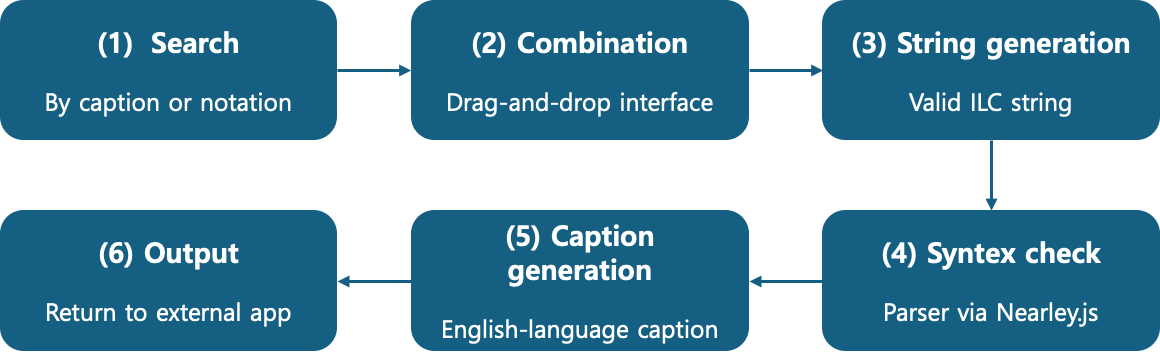
At its current experimental stage, the Builder is primarily designed to guide users in constructing syntactically valid classmarks while developing familiarity with ILC syntax. Its most notable current limitation lies in the search function, which lacks sophistication in matching retrieved building blocks to user intent; improvements such as facet compatibility search are envisioned for future development. It has also been deliberately designed to facilitate integration with external indexing applications, and could serve as a foundation for AI-assisted classification workflows, where automatically generated candidate classmarks would still benefit from its syntactic validation and semantic guidance.
2.3 KOS Registry
A KOS registry is not merely a list of knowledge organization systems, but a structured environment in which individual KOSs are described, compared, and linked through shared metadata and organizational frameworks. This perspective is grounded in the view that KOSs are not only tools for organizing knowledge, but also knowledge resources in their own right. Accordingly, a KOS registry requires its own descriptive and classificatory structure in order to support the discovery, comparison, and reuse of KOSs[2].
The K-KOS Open Archive was developed in this context as a registry that aggregates heterogeneous Korean KOSs and represents them as individual entries enriched with metadata, explanatory wiki pages, and links to external sources and international registry records. Previous work showed that simply collecting distributed KOSs was not sufficient; enhanced metadata and dedicated wiki pages were also necessary to support stable identification and understanding, especially when source websites were fragmented, insufficiently descriptive, or unstable over time[11].
Within this broader effort, multiple classification systems have been examined for organizing KOS registry entries, including DDC, KDC, EuroVoc, BRM, and ILC[12]. Comparative analysis showed that no single scheme fully addresses all registry needs, and that multiple classificatory approaches may be required to support both domestic optimization and international linkage. Among these, ILC is particularly significant because it provides a phenomenon-based framework suited to representing KOSs across applied and multidimensional domains. Moreover, the application of ILC to KOS registries predates the present K-KOS study, as ILC had already been explored for indexing KOSs in BARTOC by phenomena, perspectives, documents, and collections[2, 13, 14].
3 Applying ILC developing version to K-KOS
3.1 Research design and workflow
This study applies the developing version of the Integrative Levels Classification (ILC) to the K-KOS dataset, previously classified through ILC2-based multi-notation assignment[4]. While the earlier approach assigned multiple notations in parallel, the present study revisits selected entries by reassigning candidate notations under this version of ILC and synthesizing them into structured classmarks using the ILC Classmark Builder.
The classification process was carried out by a researcher responsible for the K-KOS registry and serving as an assistant editor of ILC, ensuring familiarity with both the dataset and the classification system. The Builder supported retrieval, combination, and syntactic validation throughout. The analysis was conducted on a selected subset of KOS entries, including representative examples used in prior presentations, rather than on the entire K-KOS dataset.
The validation process followed three stages. First, candidate classmarks were constructed and reviewed internally. Second, the constructed classmarks were reviewed by the editor-in-chief of ILC, who evaluated their syntactic correctness and semantic adequacy in representing the subject content of each KOS entry. Third, cases requiring further clarification were discussed collaboratively between the two researchers, and the agreed-upon formulations were applied as the final classmarks. This iterative process ensured that the resulting classmarks were both syntactically valid and semantically grounded in the intended meaning of the ILC system.
Rather than focusing solely on final outputs, this study emphasizes the classification process itself, documenting intermediate attempts, errors, revisions, and validation outcomes. This approach allows for the identification of recurring difficulties in facet selection, syntactic construction, and semantic interpretation.
3.2 Case examples of notation synthesis
To appreciate what synthesis adds, it helps to start from what was there before. In the K-KOS dataset, entries were represented through multi-notation assignment — two or more ILC notations listed in parallel to describe a single KOS entry, without expressing the semantic relationships between them. This serves as the baseline representation against which synthesis is evaluated in the cases below.
The following three cases were selected to represent distinct synthesis patterns encountered in the registry: intra-class synthesis within the same main class (e-sports), inter-class synthesis across different main classes (Korean Sign Language Dictionaries), and inter-class synthesis involving alternative conceptualization paths (Encyclopedia of Korean Folk Beliefs). In each case, the process moves through three steps: baseline multi-notation assignment, free-facet combination as an intermediate formulation, and facet synthesis as the final structured outcome.
Together, the cases illustrate three recurrent challenges that arise in practice: syntactic validity, conceptual interpretation, and evaluation among alternative formulations — each requiring judgment that goes beyond mechanical application of the ILC rules.
3.2.1 E-sports classification
K-KOS entry
International E-Sports Classification System research and ISO standards development (국제 e-스포츠 종목 분류 체계 연구 및 ISO 표준 개발)[15]
Baseline wg "sport; physical games"
w2v "video" (customs, in video)
Free-facet combination wg0w(2v) "sport; customs, in video"
facet synthesis wg + w2v = wg2v "sports, in video"
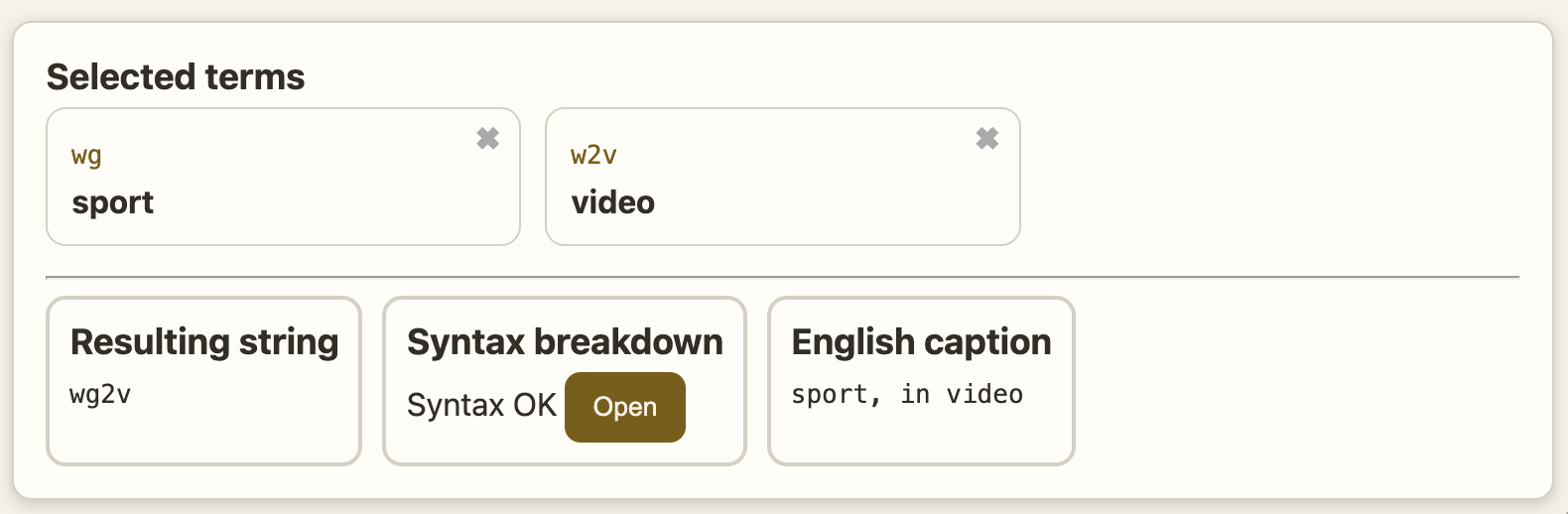
As shown in Figure 2, this case illustrates intra-class synthesis within the same main class, as the concept of 'video' is incorporated into the facet structure of 'sport'. It also shows that even a simple free-facet combination may require disambiguation, since without parentheses wg0w(2v) would be parsed incorrectly, with -2v interpreted as a facet of wg rather than as a separate related concept. Although wi2v "videogames" was considered as an alternative, wg2v was preferred because it expresses video in relation to sport rather than from the perspective of entertainment, resulting in a more compact and semantically integrated notation.
3.2.2 Korean Sign Language Dictionaries
K-KOS entry
Baseline qvw " signed languages; sign languages"
vtUq "Republic of Korea; Daehanminguk"
Free-facet combination qvw0vtUq "signed languages; Republic of Korea"
Facet synthesis qvw + vtUq = qvw92q "signed language, of Korea"
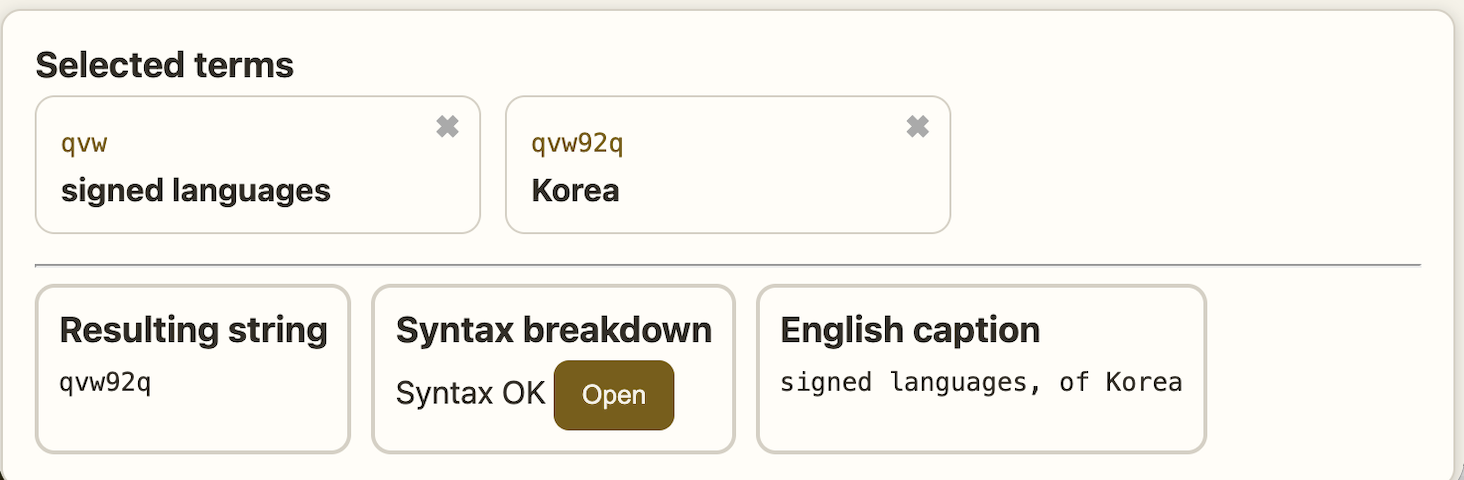
Figure 3 shows the Builder output for this case, which illustrates inter-class synthesis across different main classes and highlights the importance of conceptual interpretation in facet selection. The final synthesis was based on vtUq 'Korea', not on qvh 'Korean language', because signed languages are treated as independent languages rather than as variants of the corresponding spoken languages. Accordingly, qvw92q expresses a signed language associated with Korea rather than a Korean-language variant. It also shows that notation synthesis requires conceptual correctness as well as syntactic validity, as 92 is treated here as a parallel facet and q as the shortened focus derived from vtUq, with the initial range notation omitted.
3.2.3 Encyclopedia of Korean Folk Beliefs
K-KOS entry
Encyclopedia of Korean Folk Beliefs (한국민속신앙사전)[17]
Baseline wr "religious beliefs"
vtUq "Republic of Korea; Daehanminguk"
free-facet combination wr0vtUq "religious beliefs; Republic of Korea"
facet synthesis wr + vtUq = wr27q "religious beliefs, in Korea"
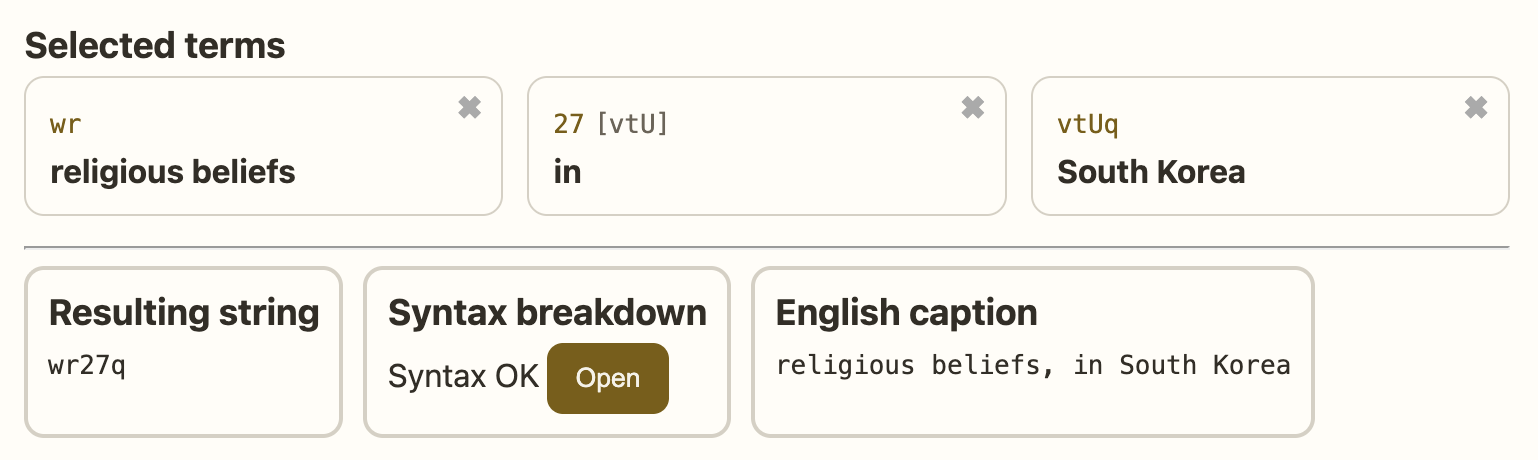
As illustrated in Figure 4, this case further demonstrates inter-class synthesis, but introduces an additional layer of complexity: when more than one formulation is possible, evaluative judgment is needed to identify the most semantically adequate path. Earlier attempts started from a different conceptualization of the KOS, combining w "customs; uses; habits; lore; tradition; rituals; religion" with uykk "Korean civilization" to produce wr20uykk, whereas the final formulation combined wr "religious beliefs" with vtUq "Republic of Korea; Daehanminguk" to produce wr27q. Although the former path allowed a possible synthesis, wr27q was ultimately preferred because it provided a more focused and semantically adequate representation of Korean folk beliefs as religious beliefs in Korea rather than as customs in Korean civilization.
3.3 Summary of synthesis patterns and implications for tool-supported classification
The three case examples show that notation synthesis is not a single uniform operation, but a series of classificatory decisions shaped by the characteristics of specific KOS entries. In this respect, the cases answer the research questions (RQs) of this study in three ways.
Regarding RQ1, multi-notation assignments in K-KOS can be transformed into structured classmarks through a stepwise process moving from baseline assignment to free-facet combination and, where appropriate, to facet synthesis. In this process, the ILC Classmark Builder supported class retrieval, combination, and syntactic checking, while final refinement depended on expert review and semantic judgment.
Regarding RQ2, faceted classmark synthesis enhanced the structural expressiveness of KOS representation by making semantic relations more explicit and by producing more integrated notational forms than baseline multi-notation assignment. Free-facet combination functioned as an intermediate step, but full synthesis offered a more precise use of the internal facet structure of the base class.
Regarding RQ3, the cases revealed three recurrent challenges in practical synthesis: syntactic validity, conceptual interpretation, and evaluation among alternative formulations. The first case showed that even apparently simple combinations may require explicit disambiguation; the second demonstrated that syntactic validity alone is insufficient without conceptual correctness; and the third showed that more than one valid synthesis path may be possible, requiring evaluative judgment to identify the most semantically adequate formulation.
Although the Builder is still at an experimental stage, this exploratory application demonstrated its practical value in supporting classmark construction in two complementary ways: syntactically, by validating notation combinations and detecting structural inconsistencies; and semantically, by retrieving candidate classes and expanding the interpretive options available to the classifier. These findings indicate that the Builder is valuable as a supporting tool, but not a substitute for classificatory expertise.
4 Conclusion
This study examined how multi-notation assignments in the K-KOS registry can be transformed into structured classmarks using the developing version of ILC and the ILC Classmark Builder. Through three representative cases, it demonstrated the practical feasibility of moving from multi-notation assignment to structured synthesis in KOS representation. In addition to its methodological contributions, this study serves as the first formal publication to document and apply the ILC Classmark Builder, making its functionality and workflow accessible to the broader knowledge organization community.
Beyond the individual examples, the study highlights an important methodological point: building a classmark is not a lookup task. Because KOS entries often cover multidimensional topics, it requires interpreting what a KOS is really about, choosing among conceptually valid alternatives, and judging which notation best captures the intended meaning. This point is especially relevant to future tool-supported or AI-assisted approaches to classification, in which generated outputs may facilitate the process but still require human judgment informed by domain knowledge and expert review grounded in classificatory expertise.
As an exploratory application based on a selected subset of K-KOS entries, the study does not propose immediate standardization for the entire registry. Rather, it offers an analytical basis for extending synthesis-based representation to a broader range of KOS entries. Future work may refine decision rules for synthesis, apply the approach to a larger body of registry data, and explore semi-automated generation of candidate classmarks in emerging tool environments. In parallel, developments in ILC infrastructure are expected to enhance interoperability and support multilingual KOS management in broader registry applications.
References
- [1] F. Mazzocchi, Knowledge organization system (KOS). ISKO Encyclopedia of Knowledge Organization, 2019. https://www.isko.org/cyclo/kos.
- [2] Z. Park, A comparative study of classification systems for organizing a KOS registry. Journal of the Korean Society for Library and Information Science, vol. 58, no. 2, pp. 269-288, 2024. https://doi.org/10.4275/KSLIS.2024.58.2.269.
- [3] Z. Park, AI for KOS discovery: Refining search, recommendation, and hallucination mitigation. Knowledge Organization, vol. 52, no. 4, 2025. https://doi.org/10.31083/KO45889.
- [4] S. Yoon, C. Gnoli, and Z. Park, Applying Integrative Levels Classification to Korean KOS Registry Bridging Phenomena and Knowledge Systems. AIDAinformazioni, vol. 43, no. 3-4, pp. 211-236, 2025.
- [5] C. Gnoli, D. Tudhope, P. Almeida, R. Barbui, C. Binding, and V. Blot, Simpler search in a complex world: Browsing ethnographic videos by freely faceted classmarks. in 7th ISKO UK Conference, Glasgow, CEUR Workshops, 2023. https://ceur-ws.org/Vol-3661/06-SHORT-CGnoli-ISKOUK2023.pdf.
- [6] C. Gnoli and E. Valenzano, Che faccetta sei? Organizzazione della conoscenza a scuola con il metodo MaVi. in 10th ISKO Italy Meeting, University of Calabria, 10–11 April 2025, AIDA informazioni, vol. 43, no. 3-4, pp. 111-120, 2025.
- [7] C. Binding, C. Gnoli, and D. Tudhope, Migrating a complex classification scheme to the Semantic Web: Expressing the Integrative Levels Classification using SKOS RDF. Journal of Documentation, vol. 77, no. 4, pp. 926-945, 2021.
- [8] C. Gnoli, R. Smiraglia, and R. Szostak, Phenomenon-based classification: An ARIST paper. Journal of the Association for Information Science and Technology, vol. 75, no. 3, pp. 324-343, 2024.
- [9] ISKO Italy, ILC Classmark Builder. https://www.iskoi.org/ilc/builder/.
- [10] K. Chandra and T. Radvan, Nearley: A parsing toolkit for JavaScript. 2014. https://doi.org/10.5281/zenodo.3897993.
- [11] Z. Park, Aggregating distributed KOSs: Enriching with meta information and linking to the multilingual KOS registry. The Electronic Library, vol. 41, pp. 755-769, 2023. https://doi.org/10.1108/EL-06-2023-0168.
- [12] K-KOS Metadata Project Team, K-KOS Open Archives. https://openarchives.net/.
- [13] C. Gnoli, Z. Park, and A. Ledl, Dimensional analysis of subjects: Indexing KOS in BARTOC by phenomena, perspectives, documents and collections. in 1st Low Countries ISKO Conference, Brussels, Belgium, June 21, 2019, 2019.
- [14] Z. Park, C. Gnoli, and D. Morelli, The second edition of the Integrative Levels Classification: Evolution of a KOS. Journal of Data and Information Science, vol. 5, no. 1, pp. 39-50, 2020. https://doi.org/10.2478/jdis-2020-0004.
- [15] K-KOS Metadata Project Team, International E-Sports Classification System research and ISO standards development. K-KOS Open Archives. https://openarchives.net/wiki/index.php?title=International_E-Sports_Classification_System_research_and_ISO_standards_development.
- [16] K-KOS Metadata Project Team, Korean Sign Language Dictionaries. K-KOS Open Archives. https://openarchives.net/wiki/index.php?title=Korean_Sign_Language_Dictionaries.
- [17] K-KOS Metadata Project Team, Encyclopedia of Korean Folk Beliefs. K-KOS Open Archives. https://openarchives.net/wiki/index.php?title=Encyclopedia_of_Korean_Folk_Beliefs.
Download this article’s references: BibTeXRISCSL-JSONHayagriva
Article details
- Published
- Section
- Full Papers
- Published in
- DCMI-2026 Seoul, South Korea Proceedings
- License
- CC BY 4.0 · open access
- Download
- Download PDF
- Markdown
- Markdown
 Described in Dublin Core
This article's metadata, in the vocabulary these proceedings are about.
- dcterms:title
- From Multi-Notation Assignment to Faceted Classmark Synthesis in K-KOS: An Exploratory Application of the Integrative Levels Classification with a Classmark Builder
- dcterms:creator
- Park, Ziyoung
- Gnoli, Claudio
- Morelli, Daniele
- dcterms:date
- 2026-09-10
- dcterms:identifier
- doi:10.23106/dcmi.952696909
- dcterms:isPartOf
- DCMI-2026 Seoul, South Korea Proceedings
- dcterms:publisher
- Dublin Core Metadata Initiative
- dcterms:type
- Text
- dcterms:language
- en
- dcterms:rights
- CC BY 4.0