

Contents
Abstract
This study examines the limitations of relationship definitions in KCR5 and proposes an extension model based on BIBFRAME 3.0 to address these issues. Although KCR5 adopts the FRBR-based entity-relationship structure, its scope remains largely focused on manifestation-level description and is primarily limited to WEMI–Agent relationships. As a result, relationships involving contextual entities such as place, time, and subject are insufficiently represented. To overcome these limitations, this study utilizes BIBFRAME 3.0 classes and properties to propose an extended relationship framework centered on contextual entities. The proposed model enhances the representation of spatiotemporal and thematic relationships within bibliographic data, enabling richer semantic connections among resources. Furthermore, this study highlights the potential for improving interoperability in international data exchange and supports the development of a semantic, knowledge graph-based bibliographic environment grounded in BIBFRAME. The findings contribute to advancing the transition from record-based cataloging to entity-based, relationship-oriented bibliographic structures in the Korean cataloging context.
1 Introduction
As the diversity of information resources increases and digital environments continue to expand, bibliographic data is shifting from a record-based, description-oriented structure toward a semantic, relationship-based model centered on entities. Traditional MARC-based bibliographic systems have been effective for describing and exchanging the physical characteristics of resources; however, they have limitations in representing contextual relationships among resources. To address these limitations, entity-relationship models such as FRBR and IFLA LRM have been applied internationally[6], along with new data models such as BIBFRAME.
KCR5, the Korean cataloging rules, is also significant in that it adopts the FRBR structure and attempts to transition toward an entity-based bibliographic framework. However, its relationship definitions remain largely limited to WEMI–Agent relationships, and connections to contextual entities such as place, time, and subject are insufficiently developed. This limitation restricts the semantic linking and expansion of bibliographic data.
Therefore, this study analyzes the limitations of relationship definitions in KCR5 and proposes an extension model based on BIBFRAME 3.0. In particular, it reconstructs relationships centered on place, time, and subject entities and represents them using an RDF-based structure to enhance semantic connections among bibliographic data. Through this approach, the study aims to suggest a direction for extending entity-based bibliographic structures in the Korean cataloging environment and improving interoperability with international standards.
2 Theoretical background
2.1 BIBFRAME 3.0
BIBFRAME is an encoding framework designed to expand bibliographic data by semantically interlinking bibliographic elements based on an entity–relationship model rather than a unit-record approach. Based on RDF (Resource Description Framework), it represents data in an entity- and relationship-oriented manner, allowing individual bibliographic elements to be identified as independent entities and their relationships to be explicitly described[2].
BIBFRAME 3.0 defines Work, Instance, and Item as its core entities and includes additional entities such as Agent, Place, Subject, and Event. This structure enables richer representation of the bibliographic context of information resources[4]. By utilizing classes and properties to define relationships among entities, BIBFRAME organizes bibliographic data as an interconnected network rather than a simple collection of records.
2.2 Bibliographic Relationships in KCR5
KCR5 introduced an FRBR-based entity-relationship bibliographic structure through its 2025 revision, marking a structural shift from the manifestation-oriented approach of KCR4. It consists of three main parts—description, access points, and relationships—and defines bibliographic resources primarily in terms of Work, Expression, Manifestation, Item, and Agent entities. By explicitly defining access points and relationships, KCR5 enhances the identification and linking of bibliographic data and provides a foundation for representing the contextual relationships among entities[1].
In particular, Part III, "Relationships," specifies how bibliographic entities are connected, with the goal of supporting users in the processes of discovery, identification, and selection[1]. The relationship framework includes general principles as well as relationships among WEMI entities, between WEMI and Agent entities, and among entities of the same type. These definitions contribute to the structural organization of bibliographic data by explicitly describing connections between entities, especially in representing the creation context of resources through author–work relationships.
However, despite these structural advancements, the practical cataloging environment still largely relies on manifestation-oriented description, and the application of relationship rules remains limited. Current KCR5 relationships are primarily confined to WEMI and Agent entities, with insufficient representation of contextual entities such as place, time, and subject. As a result, there are limitations in expanding semantic connections among bibliographic data. Therefore, the relationship structure of KCR5 needs to be extended to incorporate a broader range of entities.
3 Structure of Relationships in KCR5
Despite adopting an FRBR-based structure, KCR5 still maintains a limited scope in terms of entity definition and relationship formation. The entities defined in KCR5 include Work, Expression, Manifestation, Item, and Agent-related entities such as Person, Family, and Corporate Body, which represent a relatively reduced scope compared to international standards. In particular, the absence of contextual entities such as Place, Time-span, and Subject limits the ability to fully represent the diverse aspects of information resources.
| Original RDA | Official RDA | KCR5 |
|---|---|---|
| Work | Work | Work |
| Expression | Expression | Expression |
| Manifestation | Manifestation | Manifestation |
| Item | Item | Item |
| - | Agent | - |
| Person | Person | Person |
| - | Collective Agent | Collective Agent |
| Corporate Body | Corporate Body | - |
| Family | Family | Family |
| - | Nomen | - |
| Place | Place | - |
| - | Timespan | - |
| Concept | - | - |
| Object | - | - |
| Event | - | - |
As shown in Table 1, both Original RDA and Official RDA define a wide range of entities, including core entities such as Work, Expression, Manifestation, and Item, as well as additional entities such as Agent, Place, and Nomen[5]. In contrast, KCR5 is limited to a narrower set of entities, primarily WEMI and Agent-related entities such as Person and Family[1], and does not include contextual entities such as place, time, and subject.
This limitation in entity definition inevitably leads to simplified relationships among bibliographic entities, making it difficult to represent the complex contexts associated with the creation, transformation, and use of information resources. Furthermore, when relationships between entities are not sufficiently defined, users may face difficulties in utilizing contextual connections during resource discovery, which can ultimately reduce both accessibility and usability of bibliographic data.
Therefore, KCR5 needs to expand the scope of its entity definitions and develop a structure that supports more diverse relationships. In particular, incorporating contextual entities such as place, time, and subject is essential for enriching bibliographic data and strengthening semantic connections. KCR5 is conceptually based on the LRM and shares many theoretical principles with RDA. Nevertheless, this study adopts BIBFRAME 3.0 as a framework for extending bibliographic relationships. BIBFRAME is particularly suitable for the objectives of this study, as it is an RDF-based data model that enables the semantic structuring and interconnection of bibliographic data within a linked data environment. Moreover, as a bibliographic linked data model implemented by major national libraries, including Library of Congress, BIBFRAME offers considerable potential for ensuring international interoperability. Accordingly, this study reconstructs the relationship types in KCR5 based on BIBFRAME.
4 Structuring a BIBFRAME 3.0-Based Relationship Model
Although KCR5 adopts FRBR-based entities and achieves a structural transition, its relationships remain limited primarily to WEMI and Agent entities, and it does not sufficiently reflect various contextual elements[4]. This study proposes a reconstruction of relationship types in KCR5 based on BIBFRAME classes and properties.
4.1 Place Relationships
In the bibliographic context, place serves as an important element for identifying information resources. By linking place-related data—such as historical changes in geographic names over time—it becomes possible to enrich the historical context of resources. Furthermore, place relationships can represent the custodial history of resources by connecting past and present locations where the resource has been held or managed. This study proposes BIBFRAME classes and properties applicable to KCR5 for representing place relationships (see Table 2).
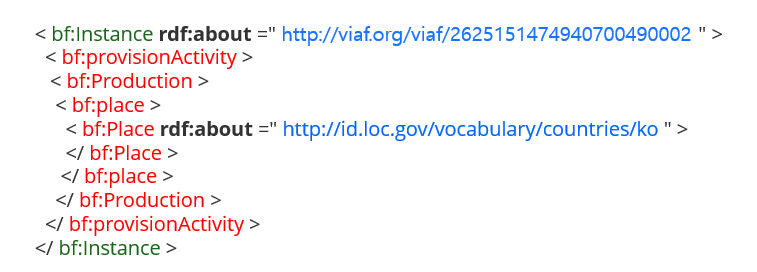
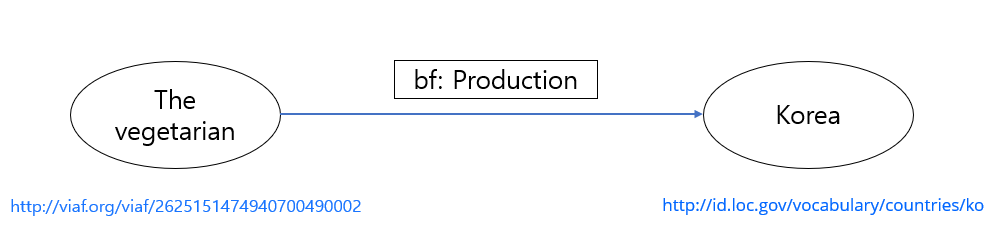
The place-related descriptive elements showed in Table 2 are not defined conceptually as entities but are instead specified as sub-elements of the manifestation. Figure 1 and Figure 2 show simplified representations of the publication of The Vegetarian, created by Han Kang, RDF format and a relationship diagram.
| KCR5 descriptive elements | place of publication, place of distribution, place of production, changes in geographic scope in edition statements, holding location, provenance-related places, notes etc |
|---|---|
| BIBFRAME 3.0 Class | bf:Place, bf:Distribution, bf:Manufacture, bf:Publication, bf:Production, bf:Modification, bf:ProvisionActivity, bf:Sublocation |
| BIBFRAME 3.0 Property | bf:geographicCoverage, bf:originPlace, bf:place, bf:physicalLocation, bf:relatedTo, bf:sublocation, |
4.2 Event (Time-span) Relationships
One of the distinctive characteristics of Korean information resources is the relatively large number of historical materials compared to those in Western contexts. To effectively represent the historical and temporal context of such resources, time information should not be treated merely as a descriptive date element but should be structured as relationships. Reflecting this characteristic, this study proposes the inclusion of a Time-span entity and suggests relevant BIBFRAME classes and properties that can be applied to and integrated with KCR5 (see Table 3).
| KCR5 descriptive elements | publication date, copyright date, acquisition date, donation date, holding date, duration of holding, notes etc |
|---|---|
| BIBFRAME 3.0 Class | bf:Chronology, bf:Generation, bf:Temporal |
| BIBFRAME 3.0 SubClass | bf:EnumerationAndChronology |
| BIBFRAME 3.0 Property | bf:custodialHistory, bf:date, bf:frequency, bf:generation, bf:historyOfWork, bf:immediateAcquisition, bf:relatedTo, bf:temporalCoverage |
| BIBFRAME 3.0 SubProperty | bf:originDate, bf:legalDate, bf:validDate, bf:phonogramDate, bf:copyrightDate, bf:changeDate, bf:creationDate, bf:generationDate |
4.3 Subject Relationships
Beyond simply describing the subject of an information resource in a unit-record format, it is possible to extend the scope of subject representation by linking related subjects within the bibliographic structure. This approach enables a broader and more interconnected understanding of subject domains. This study incorporates elements that implicitly represent subject information, such as classification numbers and titles, and proposes BIBFRAME classes and properties applicable to the Korean cataloging environment for modeling subject relationships.
| KCR5 descriptive elements | classification number, title, subject heading, notes etc |
|---|---|
| BIBFRAME 3.0 Class | bf:Classification, bf:Topic, bf:Title |
| BIBFRAME 3.0 SubClass | bf:ClssificationDdc, bf:ClssificationLcc, bf:ClssificationUdc, bf:ClssificationNlm, bf:ClssificationNal, bf:VariantTitle |
| BIBFRAME 3.0 Property | bf:classification, bf:eventContent, bf:relatedTo, bf:subject, bf:subtitle, bf:title, bf:titleOf |
5 Conclusion
The relationship extension proposed in this study aims not merely to add individual elements, but to construct an integrated relationship model that systematically reorganizes relationships among various bibliographic entities. KCR5 currently maintains a limited relationship structure centered on WEMI and Agent, which restricts its ability to fully represent the contextual aspects of information resources. To address this limitation, this study proposes a BIBFRAME 3.0-based model that integrates Place, Time-span, and Subject with the core Work–Instance–Item structure.
The proposed model adopts an RDF triple structure, where entities are identified by URIs and interconnected through properties, forming a multi-layered relationship network. This enables a richer representation of bibliographic context, including creation, temporal changes, spatial context, and thematic relationships, beyond the capabilities of traditional record-based approaches.
Furthermore, the model organizes relationships not as isolated or parallel descriptions but as a semantically interconnected network, allowing a comprehensive representation of the creation, distribution, custody, and thematic expansion of information resources. This approach transforms bibliographic data from isolated records into an interconnected knowledge structure, ultimately supporting the development of a knowledge graph-based bibliographic environment.
References
- [1] Korean Library Association Cataloging Committee, KCR5: Korean Cataloging Rules 5th edition. Korean Library Association, Seoul, 2025.
- [2] Library of Congress, Overview of the BIBFRAME 2.0 Model. 2016. https://www.loc.gov/bibframe/mtbf/.
- [3] Library of Congress, Bibliographic Framework Initiative. 2026. https://www.loc.gov/bibframe/.
- [4] Library of Congress, BIBFRAME Ontology ver. 3.0.1. 2026. https://id.loc.gov/ontologies/bibframe.html.
- [5] P. Riva, Building RDA using the FRBR library reference model. in Proceedings of the RDA in the Wider World, 2016. https://www.oclc.org/content/dam/oclc/events/2016/IFLA2016/presentations/Building-RDA-Using-the-FRBR-Library-Reference-Model.pdf.
- [6] P. Riva, P. Le Boeuf, and M. Žumer, IFLA Library Reference Model: A Conceptual Model for Bibliographic Information. International Federation of Library Associations and Institutions, 2024. https://repository.ifla.org/handle/20.500.14598/40.2.
Download this article’s references: BibTeXRISCSL-JSONHayagriva
Article details
- Published
- Section
- Short Papers
- Published in
- DCMI-2026 Seoul, South Korea Proceedings
- License
- CC BY 4.0 · open access
- Download
- Download PDF
- Markdown
- Markdown
 Described in Dublin Core
This article's metadata, in the vocabulary these proceedings are about.
- dcterms:title
- Extending KCR5 Relationships toward Integration with BIBFRAME 3.0
- dcterms:creator
- Park, Minjung
- dcterms:date
- 2026-09-10
- dcterms:identifier
- doi:10.23106/dcmi.952689118
- dcterms:isPartOf
- DCMI-2026 Seoul, South Korea Proceedings
- dcterms:publisher
- Dublin Core Metadata Initiative
- dcterms:type
- Text
- dcterms:language
- en
- dcterms:rights
- CC BY 4.0