


Contents
Abstract
This study reinterprets classification notes in the Korean Decimal Classification (KDC) as key semantic elements for automated classification and proposes a method for structuring relationships among classification entries. Existing approaches have relied on keyword-based analysis or simple mapping, limiting their ability to reflect the intellectual structure of classification systems. To address this limitation, this study analyzes the types and functions of KDC notes and identifies their roles in expressing semantic relationships, such as conceptual definition, hierarchical and associative links, subdivision rules, and exceptions. These relationships are then categorized into internal and external relations and formalized as properties within a linked data framework. This approach enables the transformation of unstructured notes into machine-processable structures and supports the development of semantically enriched, knowledge graph–based classification systems.
1 Introduction
Classification is a fundamental tool for knowledge organization that provides access points to information resources through subject analysis. Traditionally, classification schemes have established relationships among classes through hierarchical structures and various types of notes, which serve as the basis for intellectual processes such as number synthesis. However, despite the increasing demand for automated classification in the web environment, previous studies have been limited to simple mapping or keyword-based approaches, failing to adequately reflect the inherent intellectual structure of classification systems. In particular, classification notes play a crucial role in expressing diverse relationships among classes. Nevertheless, these notes are typically represented in unstructured textual forms, making them difficult for machines to interpret and utilize effectively. This limitation significantly hinders the accuracy and scalability of automated classification.
To address this issue, this study analyzes classification notes in the Korean Decimal Classification (KDC) to identify the relationships among classification entries and reinterprets them within a linked data framework. By transforming the intellectual structure of classification schemes into a machine-understandable form, this study aims to propose a semantic foundation for automated classification and to contribute to the development of intelligent classification systems.
2 Theoretical Background
With the advancement of semantic web and AI, there is increasing interest in transforming Knowledge Organization Systems (KOS) into machine-understandable structures.[1] Within linked data environments, explicitly representing relationships to construct knowledge graphs is essential for semantic-based retrieval and reasoning. This shift suggests that traditional classification should evolve from simple hierarchies into relationship-centered semantic frameworks.
Research on classification systems emphasizes that entries extend beyond hierarchy to encompass diverse semantic relations.[2] Specifically, classification notes—providing definitions, scope, and references—clarify the intellectual context of classes and define their interrelationships. These notes are vital for maintaining accuracy and consistency.
However, existing automated classification primarily relies on keyword-based or statistical methods, often failing to capture the complex rules embedded in notes.[3] Consequently, rich semantic information remains underutilized, limiting the accuracy and explainability of automated outcomes.[4]
In the Korean Decimal Classification (KDC), notes are typically unstructured, hindering machine interpretation. To advance intelligent classification, these notes must be redefined into machine-processable structures.[5] Accordingly, this study analyzes KDC notes by type and structures them into formalized relationships, proposing a linked data–based semantic framework.
3 Analysis of Functions and Distribution of KDC Notes
To design a semantic-based structure for automated classification, it is necessary to conduct a systematic analysis of the elements that constitute the intellectual structure embedded within classification systems. In particular, classification notes used in the Korean Decimal Classification (KDC) serve as key components that explain relationships among classification entries and complement classification rules. As such, they represent an important resource that provides semantic cues for automated classification.
As shown in Table 1, inclusion notes (41.05%) and reference notes (24.22%) account for more than 65% of all notes in the KDC main schedules, indicating that they are used more than any other type. This suggests that the KDC knowledge system is not merely a list of categories, but rather a structured system that defines the scope of subjects and explicitly represents relationships among related entries.
Although KDC notes describe key relationships essential for automated classification, their current unstructured textual form limits the ability of machines to interpret and infer these relationships effectively. Therefore, in order to systematically connect classification entries, it is necessary to reinterpret the functions of these notes and redefine them into relational structures that are understandable to machines.
| Note type | Frequency | Percentage | Note type | Frequency | Percentage |
|---|---|---|---|---|---|
| Inclusion | 3700 | 41.05 | addAsInstruction | 21 | 0.23 |
| SeeReference | 2183 | 24.22 | Footnote | 19 | 0.21 |
| Example | 733 | 8.13 | Facet Indicator | 7 | 0.08 |
| FormerHeading | 654 | 7.26 | Scope | 5 | 0.06 |
| Relocation | 361 | 4.00 | Preference | 4 | 0.04 |
| UseTable | 288 | 3.20 | Discontinued | 2 | 0.02 |
| Definition | 248 | 2.75 | VariantName | 1 | 0.01 |
| Subdivision | 220 | 2.44 | Arrange | 1 | 0.01 |
| ClassElsewhere | 217 | 2.41 | Provisional | 1 | 0.01 |
| ClassHere | 195 | 2.16 | MappedTo | 1 | 0.01 |
| Option | 153 | 1.70 |
4 Structuring Relationships of Classification Notes
4.1 Conceptual Design of Note-Based Relationships
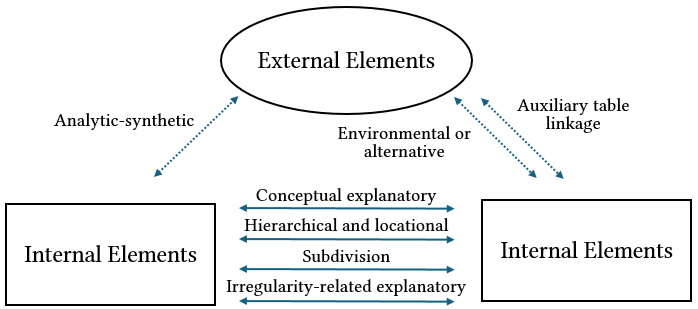
KDC notes perform various functions in describing relationships among classification entries. These relationships can be broadly categorized, based on their characteristics, into those occurring within the classification scheme itself (Internal Relations) and those formed through connections with external elements (External Relations).
Internal relations refer to semantic connections among classification entries within the main schedules of KDC and constitute the fundamental knowledge structure of the classification system. They include relationships such as inclusion, explanation, and subdivision, reflecting both the hierarchical organization and the semantic context of classification entries. In contrast, external relations are formed through links to auxiliary tables, other classification systems, or operational environments, thereby ensuring the extensibility and flexibility of the classification system. This dual structure provides a foundation for reconfiguring classification systems from simple hierarchical arrangements into multidimensional knowledge networks.
4.2 Internal and External Relation Notes
Internal relation notes define inclusion and explanatory relationships within the KDC schedules (000–999), forming the core of the classification knowledge graph. Through these notes, classification entries and class numbers are interconnected into a structured network, representing the inherent connections among classification components.
Functionally, internal relations are categorized into four subtypes: conceptual explanatory, hierarchical and locational, subdivision, and irregularity-related explanatory relations. These notes clarify concepts through definitions, scope, and examples, while establishing hierarchical and associative structures through inclusion and reference relationships, providing the semantic foundation for interpreting classification entries.
In contrast, external relations extend the system by connecting with elements outside the KDC main schedules. They enable the representation of complex subjects and multidimensional attributes by linking entries to auxiliary tables, external systems, or policy contexts. Thus, external relations enrich the linear structure of schedules by introducing faceted and contextual dimensions.
External relation notes are classified into three functional types: analytic-synthetic, auxiliary table linkage, and environmental or alternative relations. These notes support the extension of class numbers with attributes such as form or place and allow flexible application of rules. Consequently, they play a crucial role in enhancing the extensibility and contextual adaptability of the classification system.
4.3 Definition of Relationship Properties Based on Linked Data
In this study, the functional relationship types of KDC notes, along with the identified internal and external relation types, are defined as relationship properties that can be utilized within a linked data environment. Each relationship is represented as a property with a distinct semantic meaning, enabling the explicit description of connections among classification entries.
These properties transform the unstructured notes of the current KDC into relational data with unique identifiers, thereby providing a foundation for establishing semantic relationships among classification entries.
| Structure | Relationship | Property | KDC Note Type |
|---|---|---|---|
| Internal | Conceptual explanatory | hasDefinition | Definition, Scope, VariantName, Example |
| Hierarchical and locational | hasRelation | Inclusion, SeeReference, ClassHere, ClassElsewhere | |
| Subdivision | hasInstruction | Subdivision, AddAsInstructed | |
| Irregularity-related explanatory | hasValidity | FormerHeading, Discontinued, Provisional, Relocation | |
| External | Analytic-synthetic | isSynthesizedBy | Arrangement, Facet Indicator |
| Auxiliary table linkage | useTable | UseTable | |
| Environmental or alternative | hasAlternative | Footnote, Option, Preference, MappedTo |
The relationship properties proposed in Table 2 enable classification entries to be identified as individual entities and allow their semantic connections to be represented in a triple-based structure. As a result, the classification scheme can be reconstructed beyond a simple hierarchical structure into a knowledge graph composed of diverse interconnected relationships. This provides a foundation for automated classification systems to understand and infer the underlying logic of classification.
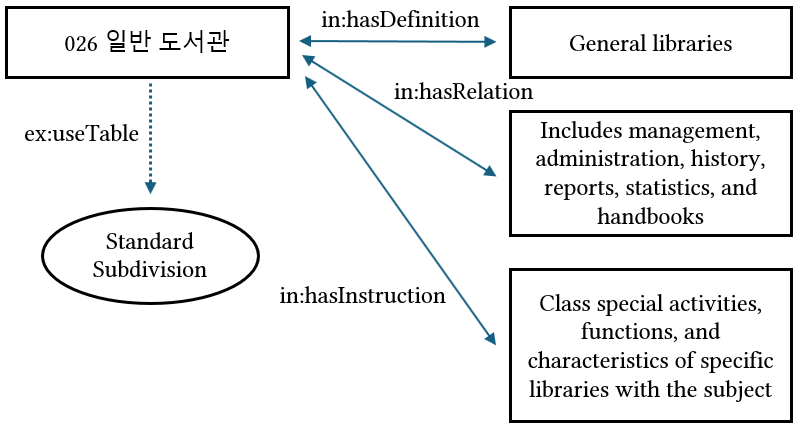
The relationship structuring of classification notes proposed in this study enhances the interpretability of classification results by explicitly representing relationships among classification entries, in contrast to existing automated classification approaches that rely on keyword-based matching and fail to provide logical justification.
Furthermore, the linked data–based structure facilitates integration with external data, enabling classification systems to function as extensible knowledge infrastructures. This suggests that, in AI-driven knowledge organization systems, classification schemes can evolve beyond simple tools to become core components of semantically enriched knowledge graphs.
5 Conclusion
This study reinterprets the semantic functions and relationship-forming roles of classification notes in the Korean Decimal Classification (KDC) as core elements for automated classification and proposes a method for structuring relationships among classification entries based on these notes. To this end, the types and distribution of notes in the 6th edition of the KDC schedules were analyzed, and the functional roles of each note type were systematically identified.
Based on this analysis, the study structures these entries into internal and external relations. Internal relations—encompassing conceptual, hierarchical, and subdivision features—constitute the core semantic structure within the classification scheme. External relations, in contrast, provide extensibility and flexibility through connections with auxiliary tables and external elements.
By defining these relationships as properties within a linked data framework, the study transforms previously unstructured textual notes into machine-processable structures. This approach provides a foundation for reconstructing classification systems as knowledge graph–based structures, thereby offering a semantic framework for automated classification. In this regard, further research is required to verify the practical usefulness of this typology and extend the relationship models, which should be addressed as future tasks alongside the standardization of the structure.
References
- [1] M. L. Zeng and P. Mayr, Knowledge Organization Systems (KOS) in the Semantic Web: A multi-dimensional review. International Journal on Digital Libraries, vol. 20, pp. 209-230, 2019. https://doi.org/10.1007/s00799-018-0241-2.
- [2] R. Green and M. Panzer, The ontological character of classes in the Dewey Decimal Classification. OCLC Online Computer Library Center, Inc., 2010. https://www.oclc.org/content/dam/oclc/dewey/news/conferences/isko2010-green-panzer.pdf.
- [3] J. Wang, An extensive study on automated Dewey Decimal Classification. Journal of the American Society for Information Science and Technology, vol. 60, no. 11, pp. 111-122, 2009. https://doi.org/10.1002/asi.21147.
- [4] K. Golub, O. Suominen, A. T. Mohammed, H. Aagaard, and O. Osterman, Automated Dewey Decimal Classification of Swedish library metadata using Annif software. Journal of Documentation, vol. 80, no. 5, pp. 1057-1079, 2024. https://doi.org/10.1108/JD-01-2022-0026.
- [5] H. Park and S. Lee, Construction of concept-based note structure for KDC 6. Journal of Korean Library and Information Science Society, vol. 55, no. 3, pp. 23-42, 2024. https://doi.org/10.16981/KLISS.55.3.202409.23.
Download this article’s references: BibTeXRISCSL-JSONHayagriva
Article details
- Published
- Section
- Short Papers
- Published in
- DCMI-2026 Seoul, South Korea Proceedings
- License
- CC BY 4.0 · open access
- Download
- Download PDF
- Markdown
- Markdown
 Described in Dublin Core
This article's metadata, in the vocabulary these proceedings are about.
- dcterms:title
- From Notes to Knowledge Management: Representing KDC Classification Notes as Linked Data for Automated Classification
- dcterms:creator
- Park, Haeryung
- Lee, Seungmin
- dcterms:date
- 2026-09-10
- dcterms:identifier
- doi:10.23106/dcmi.952677270
- dcterms:isPartOf
- DCMI-2026 Seoul, South Korea Proceedings
- dcterms:publisher
- Dublin Core Metadata Initiative
- dcterms:type
- Text
- dcterms:language
- en
- dcterms:rights
- CC BY 4.0