


Contents
Abstract
Applying the theory of representation, in this paper it is argued that the limitations of AI generated solutions are due to AI’s lack of multifaceted cultural, historical and situational contexts and beliefs that constitute the fabric of the authoritative knowledge. This paper suggests that the problem of AI is not so much of the scale of the data on which it is trained as it is the lack of depth and quality of data that represents the contextual and situated knowledge produced by human experience and cognition.
1 Introduction
Representation lies at the core of knowledge organization, shaping how knowledge is perceived, discovered, and organized. Human representation of knowledge is a complex process that takes into account not only the actual object in hand, but also its contextual and cultural values, ensuring that both its local and broader significance is accurately represented. While human information representation is not without limitations and heavily relies on information professionals’ expertise and backgrounds, humans nevertheless are able to capture the cultural richness of the represented object and apply authoritative sources to illuminate the multifaceted historical, social and contextual aspects of the object that signify its value and meaning.
Advancements of artificial intelligence (AI) technologies and their application in knowledge representation raises a number of concerns regarding the accuracy and richness of ethical representation of objects. These concerns are mainly driven by the ambiguity of how AI platforms describe, represent, and generate knowledge, such as identification of the sources utilized. As a number of studies suggest, AI systems may hallucinate and generate inaccurate information, which is often backed by fabricated or ghost references, That the value of AI for representation of knowledge remains limited is in large part of attributable to its lack of contextualized understanding of objects, which is essential for representing them within their historical, social and cultural contexts. In this paper, theory of representation is applied to an examination of the limitations of AI-generated representation.
2 Literature Review
From practical applications like information retrieval and subject indexing to more philosophical considerations like knowledge representation, AI has long been of interest of information science scholars (e.g., Smith, 1976; Schultz, Koch, & Olbrich, 2024)[13, 15]. Relatively recent research has addressed the impact of AI technologies on information services (e.g., Cox, Pinfield, & Rutter, 2019; Cox, 2023; Hirvonen, Jylhä, Lao, & Larsson, 2023)[2, 5, 11], everyday information practices (e.g., Brewer, 2023)[1], and scholarly communication (e.g., Hosseini, Rasmissen, & Resnik, 2023)[12]. Cox and Mazumdar (2022)[3], for example, have investigated the potential of AI to improve the efficiency of information services through AI-enhanced knowledge discovery and interactions (e.g., chatbots), which also produce data that help professionals better understand individual users’ behaviors. Among major associated with the use of AI systems are those related to the originality, accuracy, legitimacy and quality of the generated knowledge (e.g., Hajibayova & Lee, 2025)[6]. Application of large language models (LLMs) in knowledge organization requires careful human oversight because LLMs often fail to meet quality thresholds for accuracy, completeness, consistency as well as standards for avoiding societal and historical biases and complying with copyright requirements in the representation and organization of knowledge (Cox & Hajibayova, 2025)[4]
Information science research has increasingly raised significant ethical concerns associated with the application of AI technologies, including the accuracy of AI-generated information, biases embedded in AI training data, privacy and surveillance risks, and potential negative impact of AI on information services. For example, Hajibayova and Lee (2025)[6] argue that the ethical application of artificial intelligence technologies requires thoughtful design of knowledge representation and organization systems to ensure transparency, explainability, contextualization, and critical reflection throughout the technology- driven processes of knowledge representation, organization and discovery.
In this paper, the theory of representation is applied to examine the argument that the quality of AI generated knowledge is directly related to its representation, suggesting that without deep and multifaceted contextual and cultural information, the integrity AI generated knowledge will always lag behind of human-generated knowledge.
3 Theoretical Framework: Theory of Representation
The concept of representation has been theorized across various domains. In this paper, Hall’s (2025)[9] conceptualization of representation as the process by which signifying systems, such as language, are used to produce meaning, is applied. Hall’s theorization is grounded in the premise that things, whether objects, people or events, do not in themselves possess fixed meaning. Rather, it is humans, interacting within societies and cultures, who construct and signify meaning and signify. In this regard, humans-constructed meaning is dynamic and transforming from setting to setting, and there is no guarantee that a phenomenon will have the same or equivalent meaning in different cultures precisely because cultures do differ, sometimes radically, from one another. These differences are imbedded in their codes, which represent the ways their members carve up, classify and assign meaning to what they experience in the world. Applying the constructionist perspective to representation, Hall (2025)[10] points out that the key aspect of representation is “degree of cultural relativism between one culture and another, a certain lack of equivalence, and hence the need for translation as we move from the mind-set or conceptual universe of one culture to another” (p. 59). From this perspective, representation is juxtaposed with both the reflective and intentional approaches. Thus, one important facet of representation is acceptance of the idea of cultural relativism, the differentiation of one culture from another, resulting in a lack of equivalence and hence the need for translation as one moves from the mind-set or conceptual universe of one culture to of another. This approach to representation is called constructionist, conceived as an active generative process and therefore dynamic in contrast with more the more static reflective and intentional approaches. Hall differentiates these approaches by posing the following questions: Does language simply reflect a meaning which already exists out there in the world of objects, people and events (i.e., is reflective)? Does language express only what the speaker or writer or painter wants to say, his or her personally intended meaning (i.e., is intentional)? Or is meaning constructed in and through language (i.e., is constructionist)? (p. 11).
Embedded into the fabric of the culture, representation from the constructionist perspective involves making meaning through constructing connections among three paradigms: i) the world of things, people, events and experiences; ii) the individuals’ conceptual perceptions of the world; and iii) and signs, i.e., languages, which stand for these concepts (Hall, 2025)[10].
Moreover, to make and maintain links between systems that are not the same, so that people know what, in one system, corresponds to what in another system, then there must be something which allows them to translate between the two systems, for example, tells them what word to use for what concept. Thus, meaning is constantly altering to reflect people’s evolving perceptions, experiences and beliefs. Understanding and producing meaning depend on the practice of interpretation, which is sustained by individuals’ active use of code-encoding, wherein codes operate like social conventions (Hall, 1980)[8]. In this context, knowledge organization structures enable capture of both past and present knowledge, and, most importantly, serve as scaffolding systems for the creation of future knowledge.
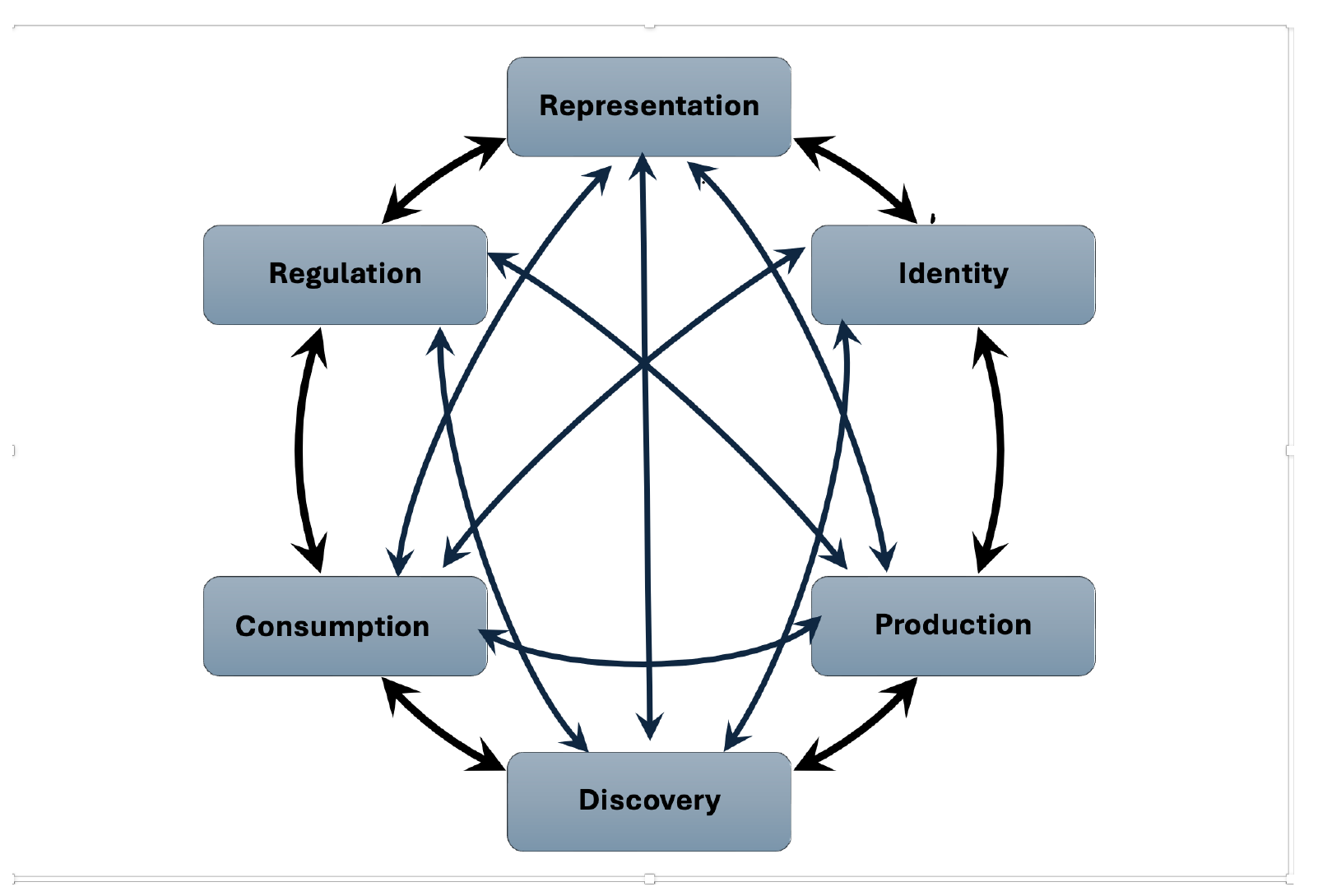
For Hall, representation is interwoven with the regulation, identity, consumption and production of knowledge (see Figure 1). In this paper it is also argued that the concept of representation is an essential part of knowledge discovery as it is tightly interconnected with the human cognition or internalized representation of the knowledge.
4 Representation and Generative AI
Given the complexity of human representation, its application within the paradigm of generative artificial intelligence produces a kind of double-edged sword effect. On one hand, generative AI systems possess powerful capacity to store, retrieve and generate knowledge at unprecedented scale and speed, but on the other hand, these systems lack understanding of the contextual and cultural signification of the things, people, objects, events and experiences which can result in biased and inaccurate information. Thus, the main problem with the AI generated knowledge is ambiguity surrounding what specific world of things, people, events and experiences is being referenced; whose perception and conceptualization of the world is being privileged; and, finally, what signs/codes the AI generated knowledge represents. Thus, without addressing the question of what constitutes representation by the AI tools and the reliability of its generated knowledge remain problematic.
Below, these concerns are exemplified by the metadata generated by OpenAI. By default, the request to generate the metadata schema for “Harry Potter and the Sorcerer’s Stone” returns the Dublin Core (DC) metadata description (see Figure 2, Figure 3)

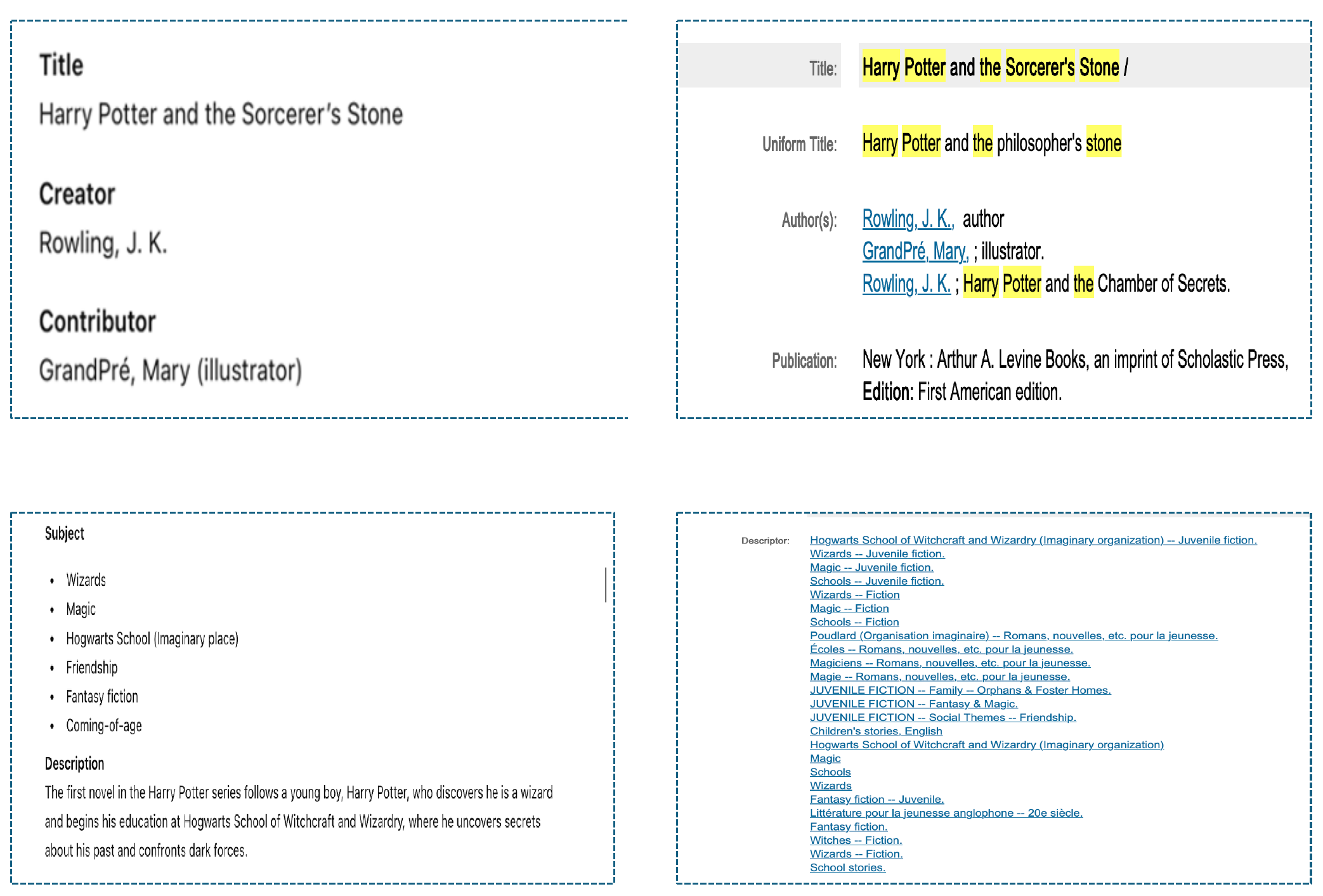
The main difference is the paucity of contextual and descriptive information in the openAI generated schema. Also, the provision of links in the WorldCat metadata enabling connection to subject and name authority files demonstrate the reliable nature of the source description and provide additional opportunities to explore the relevant sources. This example highlights a significant limitation of generative AI systems, that is, lack of transparent and accurate source attribution, which challenges the process of verification of the originality and reliability of its generated information.
5 Discussion and Conclusion
Applying the theory of representation, in this paper it is argued that the limitations or frequent so-called hallucinations of AI generated data are due to AI’s lack of multifaceted cultural, historical and situational contexts and beliefs that constitute the fabric of the reliable accurate and authoritative knowledge. It is concluded that the problem of AI is not so much of the scale of the data on which it is trained as it is the lack of depth and quality of data that represents the contextual and situated information produced by human experience and cognition.
References
- [1] R. Brewer, Understanding voice-based information uncertainty: A case study of health information seeking with voice assistants. Journal of the Association for Information Science and Technology, vol. 75, no. 10, pp. 1041-1057, 2023. https://doi.org/10.1002/asi.24854.
- [2] A. Cox, How artificial intelligence might change academic library work: Applying the competencies literature and the theory of the professions. Journal of the Association for Information Science and Technology, vol. 74, no. 3, pp. 367-380, 2023.
- [3] A. M. Cox and S. Mazumdar, Defining artificial intelligence for librarians. Journal of librarianship and information science, vol. 56, no. 2, pp. 330-340, 2024.
- [4] A. Cox and L. Hajibayova, Introduction: Artificial Intelligence (AI) and Ethical Representation, Organization, and Discovery of Knowledge. Cataloging & Classification Quarterly, vol. 63, no. 6-7, pp. 403-407, 2025.
- [5] A. Cox, S. M. Pinfield, and S. Rutter, The intelligent library: Thought leaders' views on the likely impact of artificial intelligence on academic libraries. Library Hi Tech, vol. 37, no. 3, pp. 418-435, 2019. https://doi.org/10.1108/LHT-08-2018-0105.
- [6] L. Hajibayova and S. Lee, Artificial Intelligence in Knowledge Representation, Organization and Discovery: Key Competencies and Design Considerations. Proceedings of North American Society for Knowledge Organization (NASKO), vol. 10, pp. 12-21, 2025.
- [8] S. Hall, Encoding/decoding. in Culture, Media, Language: Working Papers in Cultural Studies, 1972-1979, Routledge, 1980. https://doi.org/10.4324/9780203381182.
- [9] S. Hall, Introduction. in Representation: Cultural Representations and Signifying Practices, Sage, pp. 1-10, 2025.
- [10] S. Hall, The Work of Representation. in Representation: Cultural Representations and Signifying Practices, Sage, pp. 59-60, 2025.
- [11] N. Hirvonen, V. Jylhä, Y. Lao, and S. Larsson, Artificial intelligence in the information ecosystem: Affordances for everyday information seeking. Journal of the Association for Information Science and Technology, vol. 75, no. 10, pp. 1152-1165, 2023. https://doi.org/10.1002/asi.24860.
- [12] M. Hosseini, L. M. Rasmussen, and D. B. Resnik, Using AI to write scholarly publications. Accountability in Research, vol. 31, no. 7, pp. 715-723, 2023. https://doi.org/10.1080/08989621.2023.2168535.
- [13] D. C. Schultz, C. Koch, and R. Olbrich, Dark sides of artificial intelligence: The dangers of automated decision-making in search engine advertising. Journal of the Association for Information Science and Technology, vol. 75, no. 5, pp. 550-566, 2024. https://doi.org/10.1002/asi.24798.
- [14] C. S. Slota, K. R. Fleischmann, S. Greenberg, N. Verma, B. Cummings, L. Li, and C. Shenefiel, Locating the work of artificial intelligence ethics. Journal of the Association for Information Science and Technology, vol. 74, no. 3, pp. 311-322, 2023. https://doi.org/10.1002/asi.24638.
- [15] L. C. Smith, Artificial intelligence in information retrieval systems. Information Processing & Management, vol. 2, no. 3, pp. 189-222, 1976. https://doi.org/10.1016/0306-4573(76)90005-4.
Download this article’s references: BibTeXRISCSL-JSONHayagriva
Article details
- Published
- Section
- Full Papers
- Published in
- DCMI-2026 Seoul, South Korea Proceedings
- License
- CC BY 4.0 · open access
- Download
- Download PDF
- Markdown
- Markdown
 Described in Dublin Core
This article's metadata, in the vocabulary these proceedings are about.
- dcterms:title
- AI in Knowledge Organization: Is There a Problem with AI representation?
- dcterms:creator
- Hajibayova, Lala
- dcterms:date
- 2026-09-10
- dcterms:identifier
- doi:10.23106/dcmi.952664301
- dcterms:isPartOf
- DCMI-2026 Seoul, South Korea Proceedings
- dcterms:publisher
- Dublin Core Metadata Initiative
- dcterms:type
- Text
- dcterms:language
- en
- dcterms:rights
- CC BY 4.0