

Contents
Abstract
Cultural heritage short videos often circulate with persuasive credibility cues but weak traceability. We present a Portable Provenance Metadata Model that turns institutional records into creator-ready metadata outputs that can be attached to captions, pinned comments, overlays, or bio links with minimal friction. The model defines a compact metadata bundle (object title, place, period, brief summary, holding institution, stable link/ID, rights status, attribution text, correction note) and practical outputs (micro-citation, minimal object page, shortlink/QR, pinned correction). It targets portability barriers created by the mismatch between rapid creator production cycles and governance-bound institutional provision.
1 Background and problem
Short-video platforms (TikTok, Instagram Reels, YouTube Shorts) are now influential channels for communicating cultural heritage. Creators often compress claims about era/date, attribution, function, context, and authenticity into brief posts where credibility is inferred from visuals, narrative fluency, persona, and social feedback rather than traceable evidence. Platform affordances encourage fast, cue-based judgments (Meinert & Krämer, 2022)[4], so provenance is frequently missing or generic and inaccuracies can be easily repeated. For information institutions (libraries, archives, museums/GLAM), the challenge is that curated records, metadata, and rights information are not yet packaged in creator-friendly formats that fit short-video routines (Hughes et al., 2024)[3].
2 Evidence base and approach
We used a qualitative multi-method design combining cross-platform short-video content analysis and stakeholder interviews. A selected corpus of 125 Indonesian cultural heritage short videos was compiled from TikTok (n=45), Instagram Reels (n=40), and YouTube Shorts (n=40) through iterative keyword/hashtag searching and relational tracing (related tags, recommended videos, connected accounts). This focus on provenance visibility builds on work showing that provenance-enabled media can shape trust and accuracy perceptions (Feng et al., 2023)[2]. To explain credibility judgments, workflow constraints, and governance boundaries, we conducted semi-structured interviews with 18 creators (Google Meet where feasible; open-ended written responses followed by DM clarification when synchronous interviews were not possible). We also interviewed four LIS/archival professionals representing distinct contexts (academic library, national library, provincial library, and an archival lecturer) via Google Meet/Zoom. Interview data were analysed thematically and integrated with corpus patterns to derive the creator-ready metadata model and its design requirements.
3 Core insights motivating the model
Creators rely on multimodal cues (visuals, narration, overlays, social signals) to signal credibility, while provenance is often thin and expressed as generic mentions rather than traceable links, identifiers, or object-level records. Interviews show shared commitment to accuracy, but creators face time pressure and access frictions. A key mechanism is workflow mismatch: rapid creator production versus governance-bound institutional provision, limiting evidence portability.
4 The Portable Provenance Metadata Model
We propose a Portable Provenance Metadata Model that makes institutional evidence usable in short-video workflows (Figure 1). The model links two workflows, those are institutional provision and creator use through a lightweight, traceable metadata package grounded in provenance scholarship (Bettivia et al., 2026; Pan et al., 2023)[1, 5]. GLAM institutions verify and curate heritage information, publish a minimal reference page, and provide portable outputs (micro-citation, shortlink/QR, rights label, correction note). Creators then attach these to captions, pinned comments, overlays, or bio links, improving traceability, attribution, responsible reuse, and transparent correction (Walther & Parks, 2002; Zhao et al., 2025)[6, 7].
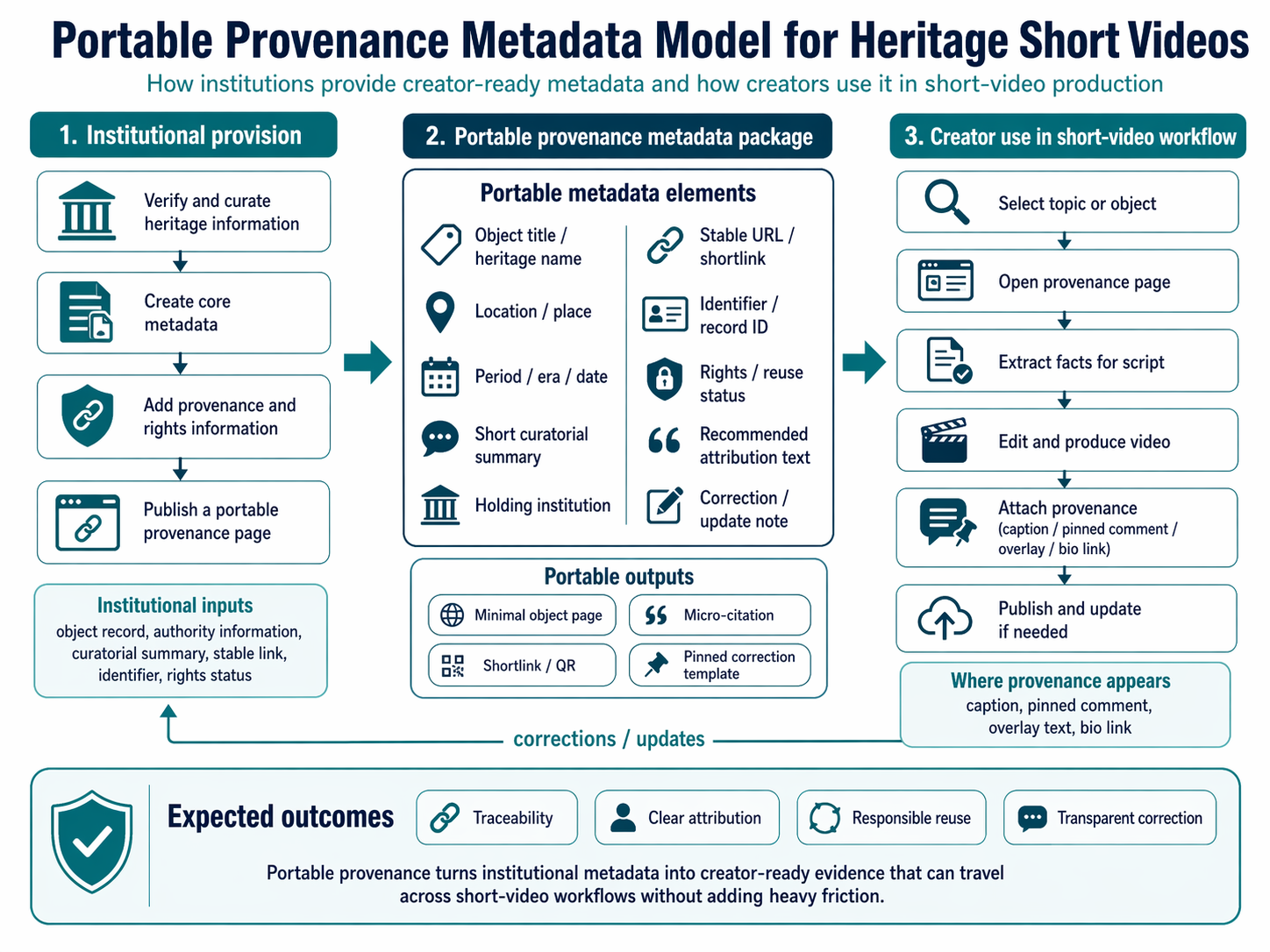
GLAM institutions provide verified heritage evidence and publish a lightweight provenance page; a portable metadata package generates creator-ready outputs (micro-citation, shortlink/QR, rights label, correction note) that creators can attach within short-video affordances; audiences gain traceability, attribution, and correction pathways. An MVP landing-page implementation is under development to operationalise the model for small-scale walkthrough testing.
Acknowledgement
This research is funded by the Indonesian Endowment Fund for Education (LPDP) on behalf of the Indonesian Ministry of Higher Education, Science and Technology and managed under the EQUITY Program (Contract No. 4300/B3/DT.03.08/2025; No.297/UN3/HK.07.00.2025) and Riset Kolaborasi Indonesia Prioritas Riset Nasional-A Scheme No.5562/B/UN3.LPPM/PT.01.03/2025.
References
- [1] R. Bettivia, Y.-Y. Cheng, and M. R. Gryk, Usage of the term provenance in LIS literature: An Annual Review of Information Science and Technology (ARIST) paper. in Journal of the Association for Information Science and Technology, vol. 77, no. 1, pp. 92-107, 2026. https://doi.org/10.1002/asi.25015.
- [2] K. K. Feng, N. Ritchie, P. Blumenthal, A. Parsons, and A. X. Zhang, Examining the impact of provenance-enabled media on trust and accuracy perceptions. in Proceedings of the ACM on Human-Computer Interaction, vol. 7, no. CSCW2, pp. 1-42, 2023. https://doi.org/10.48550/arXiv.2303.12118.
- [3] E. M. Hughes, R. Wang, P. Juneja, T. W. Li, T. Mitra, and A. X. Zhang, Viblio: Introducing credibility signals and citations to video-sharing platforms. in Proceedings of the 2024 CHI Conference on Human Factors in Computing Systems, pp. 1-20, 2024. https://doi.org/10.1145/3613904.3642490.
- [4] J. Meinert and N. C. Krämer, How the expertise heuristic accelerates decision-making and credibility judgments in social media by means of effort reduction. in PLOS ONE, vol. 17, no. 3, pp. e0264428, 2022. https://doi.org/10.1371/journal.pone.0264428.
- [5] B. Pan, N. Stakhanova, and S. Ray, Data provenance in security and privacy. in ACM Computing Surveys, vol. 55, no. 14s, pp. 1-35, 2023. https://doi.org/10.1145/3593294.
- [6] J. B. Walther and M. R. Parks, Cues filtered out, cues filtered in: Computer-mediated communication and relationships. in Handbook of interpersonal communication, Sage, pp. 529-563, 2002.
- [7] J. Zhao, H. Liu, K. Shu, Q. Fang, C. Tan, Y. Su, L. Wu, P. Liu, H. Shen, and J. Tian, Provenance of data with rights and interests in online rumor data element circulation on social media. in Humanities and Social Sciences Communications, vol. 12, no. 1, pp. 1-22, 2025. https://doi.org/10.1057/s41599-025-05437-z.
Download this article’s references: BibTeXRISCSL-JSONHayagriva
Article details
- Available
- Section
- Posters
- Published in
- DCMI 2026 Conference Proceedings
- License
- CC BY 4.0 · open access
- Download
- Download PDF
- Markdown
- Markdown
 Described in Dublin Core
This article's metadata, in the vocabulary these proceedings are about.
- dcterms:title
- Portable Provenance Metadata for Heritage Short Videos: A Creator-Ready Model for Traceability and Responsible Reuse
- dcterms:creator
- Anna, Nove E Variant
- Mannan, Endang Fitriyah
- Harisanty, Dessy
- Othman, Roslina
- Sukma, Alifian
- Rachman, Yeni Budi
- Khadijah, Ute Lies Siti
- Yanto, Andri
- dcterms:available
- 2026-08-01
- dcterms:identifier
- doi:10.23106/dcmi.952652503
- dcterms:subject
- metadata
- provenance
- cultural heritage
- short video
- credibility
- GLAM
- Sustainable cities and communities
- dcterms:isPartOf
- DCMI 2026 Conference Proceedings
- dcterms:publisher
- Dublin Core Metadata Initiative
- dcterms:type
- Text
- dcterms:language
- en
- dcterms:rights
- CC BY 4.0