


Contents
Abstract
The retirement of the HathiTrust Research Center (HTRC) infrastructure raises questions about continuing computational research on in-copyright collections in the HathiTrust Digital Library (HTDL). Since HTRC has actively supported inclusive research on underrepresented groups, the HTDL collections serve as a crucial test case for exploring post-HTRC workflows. To address this, we share an augmented dataset of American poetry by poets from historically underrepresented groups in the HTDL. Mapping this collection to HTRC Extracted Features (EF) v2.5 demonstrated that EF is highly reliable with high retrieval coverage, achieving a 100\% match. Our computational linguistic analysis shows that EF effectively captures group-specific diversity, such as non-standard English, indigenous languages, and multilingual vocabularies. These findings indicate that adapting ML and NLP tools to properly handle such linguistic variation is essential to mitigate bias and marginalization. Although the lack of full-text limits structural analysis, EF remains a sustainable and highly useful resource for word-based research well beyond the HTRC's retirement.
1 Introduction
The HathiTrust Research Center (HTRC) has developed the HathiTrust Extracted Features (EF) dataset, a derived metadata representation of the HathiTrust Digital Library (HTDL). The EF dataset provides linguistic features, including token counts, part-of-speech tags, and page-level metadata, extracted from OCR-processed texts[1]. This derived metadata allows computational analysis of both public-domain and in-copyright materials under non-consumptive research conditions. In addition to EF, HTRC has also provided infrastructure, including the Data Capsule, a secure virtual environment that enables researchers to access and analyze full-text HTDL content. However, the HTRC infrastructure is scheduled for retirement in 2026[2]. While EF access is expected to remain available, this transition raises important questions about whether EF alone can sustain computational research on HathiTrust collections in the future.
This change particularly affects research on historically underrepresented literary collections, which often involves in-copyright texts[3, 4]. Historically, literary analysis has focused on canonical texts, standard English, and some widely studied authors[5–7]. To address this imbalance, HTRC has supported inclusive initiatives such as SCWAReD[8]. Aligned with these efforts, our previous work introduced a curated collection of American poetry by poets from historically underrepresented groups in the HTDL[9], which we call the Poets from Historically Underrepresented Groups (PHUG) dataset. Providing a curated list of volume IDs was sufficient as long as the HTRC Data Capsule was available, allowing researchers to securely access and analyze the full-text data. However, the retirement of HTRC will soon make this workflow no longer viable, raising questions about the continued computational analysis of culturally diverse, in-copyright texts.
To address this challenge, this paper introduces the Extracted Features (EF) version of the PHUG dataset. Using this derived metadata representation, we demonstrate how EF-based features can support computational literary analysis of HTDL materials without direct access to full text. Finally, through this case study, we explore how derived feature representations, such as EF, can serve as sustainable and equitable metadata for AI-driven analysis of culturally diverse literary collections in a post-HTRC era.
2 Datasets
2.1 HathiTrust Extracted Features
The HathiTrust Research Center (HTRC), established in 2011, supports large-scale computational analysis of works in the HathiTrust Digital Library (HTDL). The Center develops infrastructure, tools, and datasets that support massive text and data mining of the HTDL corpus for educational and non-profit research. Through these services, HTRC provides researchers with computational access to vast digital collections while adhering to copyright laws and non-consumptive research practices.
The HathiTrust Extracted Features (EF) dataset provides a set of structured features derived from OCR-processed pages. These features include volume-level metadata, page-level metadata, token counts, and part-of-speech (POS) tagged tokens generated using the Stanford NLP library[10, 11]. Files are distributed in JSON-LD format. The EF dataset contains more than 18 million volumes, 6.8 billion pages, and 3.2 trillion tokens, including both public-domain and in-copyright items.
EF enables broad-scale computational analyses, such as lexical, stylistic, and genre-based studies, across the HTDL collections without violating copyright restrictions. Previous studies have used EF-based features for tasks such as word similarity[12], topic modeling[13], and literary genre identification[14]. Despite its usability, the linguistic features in EF are derived from OCR-processed text, which may contain OCR errors. These errors can influence subsequent tokenization and POS tagging. In addition, general-purpose POS taggers, such as the Stanford NLP parser, are typically trained on modern prose and may perform less reliably on non-standard, domain-specific texts, including poetry. These inherent limitations should be considered when interpreting token-level results.
In October 2024, HathiTrust Executive Director Mike Furlough announced that HathiTrust will cease funding and data access for the HTRC at the end of 2026. Since the announcement, HTRC has been preparing a transition and sunsetting process. Unlike the discontinued access to Data Capsule, access to HTDL, Bookworm, and derived datasets, including EF, will remain available. As a result, EF is expected to remain an important resource for computational analysis of the HathiTrust collections after the retirement of the HTRC infrastructure.
2.2 Poets from Historically Underrepresented Groups (PHUG) Dataset
In this study, we build on the PHUG dataset introduced by Kang and Choi[9], a curated collection of American poetry by poets from historically underrepresented groups in the HTDL. The dataset comprises 4,723 poems from 120 collections by African American (AA), Asian American (APA-AA), Pacific Islander (APA-PA), Latin American (LXA), and Native American (NA) poets, with a detailed breakdown provided in Appendix Table Table A1. Most importantly, it provides poem-level boundary annotations, including the start and end page numbers of each poem. This structural metadata enables large-scale computational poetry analysis through retrieving poem records in HTRC EF.
To construct the derived metadata representation, we cross-referenced the PHUG dataset with EF. Initially, we used EF v2.0, yielding 92% coverage, with 8 volumes and 375 poems missing. By upgrading to EF v2.5, retrieval coverage reached 100%; all 4,723 poems across 120 volumes were matched to their corresponding EF data. This shows the high reliability and robustness of the EF dataset.
We also observed meaningful qualitative improvements in token extraction in v2.5, resulting from HTRC's recently updated OCR pipeline. When comparing the exclusive words extracted from both versions, we found that EF v2.5 more accurately recovers orthographically complex forms, especially words with apostrophes and diacritics. For instance, words that appeared in EF v2.0 in simplified or degraded forms such as Wen, shiyazhf, Hooulu, tia, que, and Dine are correctly captured in EF v2.5 as W'en, Shiy'azh'i, Hoʻoulu, tía, Qué, and Diné. These examples demonstrate how improved OCR processing preserves critical orthographic markers that the earlier algorithms often missed. Such enhanced token recognition allows a more robust linguistic analysis across diverse and non-standard language forms. The matching extracted features and analysis code are publicly available via Zenodo and GitHub, respectively.1
3 Linguistic Diversity Analysis
3.1 Method
To identify unique linguistic characteristics and culturally specific words for each poet group, we conducted an exclusive word analysis using token frequency from EF. We chose this approach because general POS taggers perform poorly on poetry, and we preserved original capitalization to identify culturally significant proper nouns and capture deliberate stylistic emphasis. We recognized that a strict zero-tolerance criterion (a threshold of 0) was too restrictive and would eliminate highly distinctive terms that appeared only rarely in other groups.
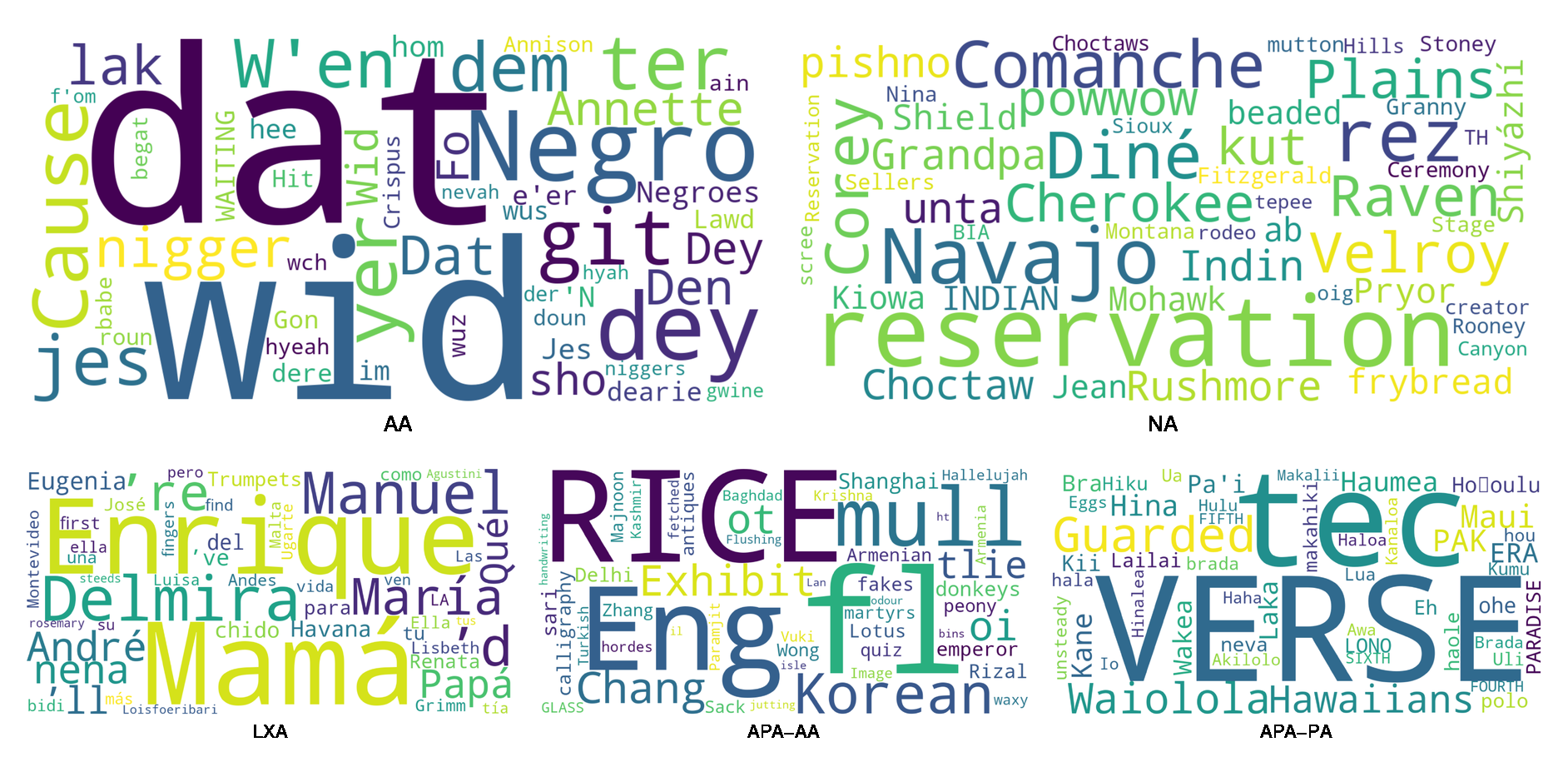
To address this, we empirically tested a cross-group overlap threshold, increasing it incrementally. We observed no significant changes beyond a threshold of 2; a threshold of 3 yielded few new words, and those added tended to have relatively low frequencies. Therefore, we set the final threshold at 2. This slightly relaxed approach helped retain important, high-frequency words that are distinctive in a particular group, such as Dat and dere in the AA group, without compromising overall cross-group distinctiveness. We visualized the top 50 exclusive words per group with a threshold of 2 in Figure 1. Frequency counts and ranked word lists are provided in Table Table B1 in the Appendix.
3.2 Results and Discussion
In the African American (AA) group, the most frequent exclusive words represent African American English (AAE) variants and African American Vernacular English (AAVE). For example, 'dat', which indicates a common pronunciation of 'that' in AAE[15], appears 154 times and 'wid' referring to 'with' in AAVE has 124 counts, along with 99 counts of 'dey' meaning 'they' in AAVE. 'fo (Fo)' meaning 'for', reflects a common characteristic of AAE known as r-dropping, in which the final r/ is not pronounced[15].
Asian American (APA-AA) group has the fewest exclusive word counts, indicating that the group is less homogeneous than the other groups. There are more words referring to various cultures and locations than other groups. 'RICE (rice)' appears 28 times across the corpus, which holds cultural, agricultural, and culinary significance in Asian countries[16, 17]. 'Korean' (16 counts), 'Shanghai' (13), 'Armenian' (8), 'Kashmir' (7), 'Baghdad' (7), 'Turkish' (7), 'Delhi' (6), 'Nepal' (6) and 'Armenia' (6) demonstrate the diversity of ethnicity and nationality within the same group. Some popular surnames for specific ethnic groups, such as 'Chang' (16), 'Wong' (9), and 'Zhang', (8) are also included in the APA-AA exclusive word list. Names are important indicators for inferential ethnic classification, which overcomes the limitation of an aggregate Asian American category[18].
Pacific Islander (APA-PA) group's exclusive words display the most linguistic distinctiveness. The words 'Waiolola' and 'Waiololi', both of which count 43 times, are respectively a female and male figure from The Kumulipo, the creation chant in Hawaiian religion, written by Liliuokalani, Queen of Hawaii. The former translates as 'broad stream' and the latter as 'narrow stream'[19]. However, direct translations do not deliver the significance of the mythic figures throughout the narrative poem. These examples indicate that preserving linguistic originality in multilingual poetry is important because direct translations can hinder multiple interpretations of original words and their musicality in the poem[19].
In Latin American (LXA) group, ethnic personal words frequently appear: 'Enrique' (80 counts), 'Delmira' (73), 'Manuel' (64), María (48), 'André' (41), 'Eugenia' (35), 'Renata' (24), 'Lisbeth' (16), 'Luisa' (14), 'Ugarte' (14), and 'Agustini' (12)[20]. This shows a balanced mix of male and female names, but there are more words referring to women: 'Mamá' (98), 'nena' (40), 'Ella' (17), 'ella' (14), and 'tía' (13), respectively translating as 'mom', 'little girl', 'she/her', and 'aunt'[21]. Location words, such as 'Havana' (30), 'Montevideo' (16), 'Andes' (16), 'Minas' (10), and 'Juarez' (10), demonstrate that LXA poets have different national backgrounds, including Cuba, Uruguay, Brazil, and Mexico. Interestingly, unlike APA-AA group, in which there are words referring to ethnicity and country names, LXA group has more words of city names.
Native American (NA) group has a lot of words related to NA history and culture. The most frequent exclusive word 'reservation' with 87 counts and the third most frequent word 'rez' with 45 counts both refer to a designated land area managed by a Native American tribe. In addition, popular tribe names appear in the word list: 'Navajo' (51 counts), 'Comanche' (35), 'Diné' (35), 'Cherokee' (23), 'Choctaw' (20), 'Mohawk' (17), 'Kiowa' (15), 'Sioux' (13), 'Choctaws' (13), 'Stoney' (12), and 'Navajos' (11). Some words, such as 'Directions' (22)[22], 'powwow' (21; a Native American ritual), 'frybread' (18; traditional Native American food), INDIAN (Indian) (17), 'Ceremony' (14), and 'tepee' (11; a traditional Native American tent) represent Native American culture and history[23–27]. Many counts of community-related words, such as 'Grandpa' (21), 'pishno' (21; meaning 'we', 'us', 'ours')[28], and 'Granny' (16), as well as nature- and landscape-related words, including 'Raven' (27), 'Plains' (24), 'Rushmore' (20), and 'shiprock' (11), indicate NA group's iconic interests in family and the natural environment[29–31].
4 Conclusion
This study explores the feasibility of sustainable computational research on underrepresented literary collections using only derived metadata following the retirement of the HTRC infrastructure. We share an augmented PHUG dataset mapped to HTRC Extracted Features (EF) v2.5. Achieving 100% coverage across all 120 volumes and 4,723 poems demonstrates the high reliability of the EF dataset for this purpose. Our analysis revealed unique linguistic diversity across poet groups, indicating that ML/NLP tools can more effectively process these collections when designed to accommodate diverse linguistic forms and culturally specific expressions. Although the lack of full text limits structural analysis, EF shows promising potential for word-based research. Before the HTRC retirement, we plan to expand the currently small APA-PA corpus to better represent the group.
Acknowledgments
This work is supported by the Institute of Museum and Library Services (Grant No. RE-252382-OLS-22) under the Laura Bush 21st Century Librarian Program.
References
- [1] HathiTrust Research Center, Extracted Features v.2.5. 2026. https://go.illinois.edu/EF25.
- [2] HathiTrust Research Center, 2026 HTRC Transition Guide. 2026. https://htrc.atlassian.net/wiki/spaces/COM/pages/1324810243/2026+HTRC+Transition+Guide.
- [3] K. Ibacache, Building an underrepresented collection. in Building Library Collections and Curriculum Centered on Indigenous Knowledge, Routledge, 2024. https://doi.org/10.4324/9781032660561-2.
- [4] K. P. Alexander, D. Terry, J. Kirby, R. J. Wittmann, and A. Neatrour, The invisible default: Examining representation in digital collections. Information Technology and Libraries, vol. 44, no. 3, 2025. https://doi.org/10.5860/ital.v44i3.17306.
- [5] G. M. Gugelberger, Decolonizing the canon: Considerations of third world literature. New Literary History, vol. 22, no. 3, pp. 505-524, 1991. https://www.jstor.org/stable/469201.
- [6] J. Marx, Western literary canon. in The Cambridge Companion to Postcolonial Literary Studies, pp. 83, 2004.
- [7] L. Zhang, Canon and world literature. Journal of World Literature, vol. 1, no. 1, pp. 119-127, 2016. https://doi.org/10.1163/24056480-00101012.
- [8] I. Magni, R. Dubnicek, J. González, J. Swatscheno, G. Layne-Worthey, J. S. Downie, M. Graham, and J. A. Walsh, The SCWAReD projects: Scholar-Curated Worksets for Analysis, Reuse & Dissemination. in #dariahTeach Open Education Resources for the Digital Arts and Humanities, 2025.
- [9] G. Kang and K. Choi, A dataset of American poetry by poets from historically underrepresented groups in the HathiTrust Digital Library. Journal of Open Humanities Data, vol. 12, no. 1, 2026.
- [10] J. A. Walsh, G. Layne-Worthey, J. Jett, B. Capitanu, P. Organisciak, R. Dubnicek, and J. S. Downie, "The library is open!": Open data and an open API for the HathiTrust Digital Library. in CHR, pp. 703-714, 2023.
- [11] J. A. Walsh, B. Capitanu, R. Dubnicek, J. Jett, D. Kudeki, G. Layne-Worthey, S. Liyanage, P. Organisciak, S. Puthanveetil Satheesan, L. Sepúlveda Torres, J. Swatscheno, and J. S. Downie, The HathiTrust Research Center Extracted Features Dataset (2.5). HathiTrust Research Center, 2025. https://doi.org/10.13012/PXP0-F135.
- [12] D. Mimno, Word Similarity Tool, Extracted Features in the Wild. HathiTrust Research Center Wiki. https://htrc.atlassian.net/wiki/spaces/COM/pages/43289591/Extracted+Features+in+the+Wild.
- [13] P. Organisciak, Within-Book Topic Modeling, Extracted Features in the Wild. HathiTrust Research Center Wiki. https://htrc.atlassian.net/wiki/spaces/COM/pages/43289591/Extracted+Features+in+the+Wild.
- [14] HathiTrust Research Center, Extracted Features 2.0 Use Cases and Examples, Use Case 1: Using EF to identify poetry and prose volumes. HathiTrust Research Center Wiki. https://htrc.atlassian.net/wiki/spaces/COM/pages/43288220/Extracted+Features+2.0+Use+Cases+and+Examples.
- [15] J. Graham, N. L. Day-Vines, and K. Zaccor, Dis, Dat, and Dem: Addressing linguistic awareness for counselors of African American English speakers. Journal of Multicultural Counseling and Development, vol. 50, no. 2, pp. 73-81, 2022. https://doi.org/10.1002/jmcd.12241.
- [16] D. Q. Fuller, Pathways to Asian civilizations: Tracing the origins and spread of rice and rice cultures. Rice, vol. 4, no. 3-4, pp. 78-92, 2011. https://doi.org/10.1007/s12284-011-9078-7.
- [17] K. H. Ko, The influence of rice agriculture on East Asian culture and language. European Journal of East Asian Studies, vol. 15, no. 1, pp. 86-107, 2016. https://doi.org/10.1163/15700615-01501001.
- [18] D. S. Lauderdale and B. Kestenbaum, Asian American ethnic identification by surname. Population Research and Policy Review, vol. 19, no. 1, pp. 283-300, 2000. https://doi.org/10.1023/A:1026582308352.
- [19] B. N. McDougall, Moʻokūʻauhau versus colonial entitlement in English translations of the Kumulipo. American Quarterly, vol. 67, no. 3, pp. 749-779, 2015. https://doi.org/10.1353/aq.2015.0054.
- [20] M. Aceto, Ethnic personal names and multiple identities in Anglophone Caribbean speech communities in Latin America. Language in Society, vol. 31, no. 4, pp. 577-608, 2002.
- [21] SpanishDict, SpanishDict. 2026. https://www.spanishdict.com/.
- [22] Akta Lakota Museum & Cultural Center, Native American Four Directions. https://aktalakota.stjo.org/lakota-culture/native-american-four-directions/.
- [23] A. Axtmann, Performative power in Native America: Powwow dancing. Dance Research Journal, vol. 33, no. 1, pp. 7-22, 2001. https://doi.org/10.2307/1478853.
- [24] J. A. Cross, Native American landscapes in the Plains and Northwest Coast. in Ethnic Landscapes of America, Springer, pp. 47-64, 2017.
- [25] D. Mihesuah, Indigenous health initiatives, frybread, and the marketing of nontraditional "traditional" American Indian foods. Native American and Indigenous Studies, vol. 3, no. 2, pp. 45-69, 2016.
- [26] L. Roy, Four directions: An indigenous educational model. Wicazo Sa Review, vol. 13, no. 2, pp. 59-69, 1998. https://www.jstor.org/stable/1409146.
- [27] S. Willis, The four directions. International Journal of Art & Design Education, vol. 24, no. 1, pp. 31-42, 2005. https://doi.org/10.1111/j.1476-8070.2005.00421.x.
- [28] Wiktionary contributors, pishno. 2026. https://en.wiktionary.org/wiki/pishno.
- [29] A. L. Booth, We are the land: Native American views of nature. in Nature Across Cultures: Views of Nature and the Environment in Non-Western Cultures, Springer, pp. 329-349, 2003.
- [30] C. Byington, Grammar of the Choctaw Language. McCalla & Stavely, printers, 1870.
- [31] H. N. Weaver and B. J. White, The Native American family circle: Roots of resiliency. in Cross-Cultural Practice with Couples and Families, Routledge, pp. 67-79, 2019.
Appendix A PHUG Dataset Statistics
| Poet Group | Volumes | Poems |
|---|---|---|
| African American (AA) | 34 | 1,494 |
| Asian American (APA-AA) | 22 | 761 |
| Pacific Islander (APA-PA) | 3 | 134 |
| Latin American (LXA) | 26 | 948 |
| Native American (NA) | 35 | 1,386 |
| Total | 120 | 4,723 |
Appendix B Exclusive Word Lists
| Rank | aa_poets | apa-aa_poets | apa-pa_poets | lxa_poets | na_poets | |||||
|---|---|---|---|---|---|---|---|---|---|---|
| Word | Count (Elsewhere) | Word | Count (Elsewhere) | Word | Count (Elsewhere) | Word | Count (Elsewhere) | Word | Count (Elsewhere) | |
| 1 | dat | 154 (2) | fl | 29 (0) | VERSE | 55 (0) | Mamá | 98 (0) | reservation | 87 (1) |
| 2 | wid | 124 (0) | RICE | 28 (1) | tec | 45 (0) | Enrique | 80 (0) | Navajo | 51 (1) |
| 3 | Negro | 110 (0) | Eng | 23 (0) | Guarded | 43 (0) | Delmira | 73 (0) | rez | 45 (0) |
| 4 | dey | 99 (0) | mull | 19 (0) | Waiolola | 43 (0) | Manuel | 64 (1) | Comanche | 35 (2) |
| 5 | git | 67 (0) | Korean | 16 (2) | Waiololi | 43 (0) | ’d | 55 (2) | Diné | 35 (0) |
| 6 | Cause | 66 (2) | Chang | 16 (0) | Hawaiians | 34 (0) | ’re | 49 (0) | Corey | 30 (0) |
| 7 | ter | 63 (1) | Exhibit | 16 (1) | Maui | 22 (0) | María | 48 (1) | Raven | 27 (1) |
| 8 | yer | 62 (0) | oi | 15 (0) | PAK | 20 (0) | André | 41 (1) | Velroy | 26 (0) |
| 9 | jes | 61 (0) | ot | 15 (0) | Hina | 18 (1) | nena | 40 (0) | Plains | 24 (1) |
| 10 | W'en | 59 (0) | tlie | 13 (1) | Kane | 17 (0) | Papá | 39 (0) | Cherokee | 23 (2) |
| 11 | dem | 59 (0) | Shanghai | 13 (0) | ERA | 16 (0) | Qué | 36 (0) | kut | 22 (0) |
| 12 | nigger | 56 (0) | donkeys | 12 (1) | Haumea | 16 (0) | ’ll | 35 (2) | powwow | 21 (0) |
| 13 | Dat | 54 (1) | sari | 12 (0) | Wakea | 14 (0) | Eugenia | 35 (0) | Grandpa | 21 (0) |
| 14 | lak | 54 (0) | Delhi | 11 (0) | Laka | 14 (0) | ’ve | 30 (1) | Indin | 21 (0) |
| 15 | Den | 44 (0) | emperor | 11 (2) | Pa'i | 13 (0) | Havana | 30 (0) | unta | 21 (0) |
| 16 | Annette | 42 (0) | Rizal | 11 (0) | Kii | 11 (0) | chido | 28 (0) | pishno | 21 (0) |
| 17 | Fo | 38 (1) | Lotus | 10 (1) | Bra | 11 (0) | del | 27 (2) | Rushmore | 20 (2) |
| 18 | Dey | 37 (0) | calligraphy | 10 (2) | Hoʻoulu | 10 (0) | Trumpets | 25 (0) | Choctaw | 20 (1) |
| 19 | sho | 36 (0) | fakes | 10 (0) | ohe | 10 (0) | para | 24 (0) | frybread | 18 (0) |
| 20 | Wid | 36 (0) | Wong | 9 (1) | haole | 9 (1) | Renata | 24 (0) | Pryor | 18 (1) |
| 21 | Negroes | 35 (1) | quiz | 9 (2) | Lailai | 9 (0) | tu | 22 (2) | Shiyázhí | 18 (0) |
| 22 | hom | 35 (0) | peony | 9 (0) | polo | 9 (2) | como | 19 (0) | Shield | 18 (1) |
| 23 | Jes | 34 (0) | antiques | 9 (1) | Eh | 9 (2) | José | 19 (0) | INDIAN | 17 (2) |
| 24 | ’N | 33 (1) | Armenian | 9 (1) | neva | 9 (0) | first | 18 (0) | ab | 17 (0) |
| 25 | e'er | 32 (2) | martyrs | 8 (2) | LONO | 9 (0) | una | 17 (1) | Mohawk | 17 (1) |
| 26 | im | 31 (1) | Majnoon | 8 (0) | PARADISE | 9 (1) | Ella | 17 (2) | Kiowa | 16 (0) |
| 27 | hee | 31 (1) | Sack | 8 (0) | Hiku | 8 (0) | Grimm | 17 (2) | beaded | 16 (2) |
| 28 | dearie | 29 (0) | Zhang | 8 (0) | makahiki | 8 (0) | Andes | 16 (1) | Jean | 16 (2) |
| 29 | WAITING | 29 (2) | Hallelujah | 7 (1) | unsteady | 7 (2) | Montevideo | 16 (0) | Fitzgerald | 16 (1) |
| 30 | wus | 28 (0) | Vuki | 7 (0) | Uli | 7 (0) | Lisbeth | 16 (0) | Granny | 16 (0) |
| 31 | Lawd | 28 (0) | Baghdad | 7 (1) | Lua | 7 (0) | más | 15 (0) | Stoney | 14 (0) |
| 32 | dere | 27 (2) | Krishna | 7 (0) | Ua | 7 (0) | vida | 15 (1) | Montana | 14 (2) |
| 33 | Gon | 27 (2) | hordes | 7 (1) | hou | 7 (1) | LA | 15 (2) | mutton | 14 (0) |
| 34 | wuz | 26 (0) | Kashmir | 7 (0) | hala | 7 (1) | Malta | 15 (0) | Ceremony | 14 (1) |
| 35 | Hit | 25 (1) | GLASS | 7 (1) | brada | 7 (0) | fingers | 15 (0) | Sellers | 14 (0) |
| 36 | roun | 23 (0) | Armenia | 7 (1) | Kumu | 7 (0) | find | 15 (0) | Stage | 14 (1) |
| 37 | Crispus | 23 (0) | Image | 7 (1) | Hulu | 6 (0) | bidi | 15 (0) | Nina | 14 (2) |
| 38 | babe | 22 (2) | Turkish | 7 (2) | Awa | 6 (0) | Las | 14 (2) | Rooney | 13 (0) |
| 39 | doun | 22 (0) | waxy | 7 (2) | Akilolo | 6 (0) | Ugarte | 14 (0) | Choctaws | 13 (0) |
| 40 | ain | 22 (1) | Paramjit | 7 (0) | Haha | 6 (0) | ella | 14 (0) | TH | 13 (0) |
| 41 | wch | 22 (1) | fetched | 7 (2) | Eggs | 6 (0) | Luisa | 14 (0) | Hills | 12 (2) |
| 42 | Annison | 21 (0) | Flushing | 7 (0) | Io | 6 (2) | su | 13 (0) | BIA | 12 (0) |
| 43 | hyeah | 21 (0) | Lan | 6 (0) | Kanaloa | 6 (0) | ven | 13 (0) | oig | 12 (0) |
| 44 | begat | 21 (2) | handwriting | 6 (2) | Hinalea | 6 (0) | pero | 13 (1) | Sioux | 12 (0) |
| 45 | der | 20 (1) | il | 6 (0) | Haloa | 6 (0) | tía | 13 (0) | creator | 12 (1) |
| 46 | niggers | 20 (0) | jutting | 6 (2) | Brada | 6 (0) | Loisfoeribari | 13 (0) | scree | 12 (0) |
| 47 | nevah | 20 (0) | odour | 6 (1) | Makalii | 5 (0) | tus | 12 (0) | tepee | 11 (0) |
| 48 | hyah | 20 (0) | ht | 6 (0) | SIXTH | 5 (0) | Agustini | 12 (0) | Canyon | 11 (2) |
| 49 | f'om | 20 (0) | isle | 6 (2) | FIFTH | 5 (0) | rosemary | 12 (1) | rodeo | 11 (2) |
| 50 | gwine | 20 (0) | bins | 6 (1) | FOURTH | 5 (2) | steeds | 12 (2) | Reservation | 11 (0) |
Notes
Download this article’s references: BibTeXRISCSL-JSONHayagriva
Article details
- Published
- Section
- Short Papers
- Published in
- DCMI-2026 Seoul, South Korea Proceedings
- License
- CC BY 4.0 · open access
- Download
- Download PDF
- Markdown
- Markdown
 Described in Dublin Core
This article's metadata, in the vocabulary these proceedings are about.
- dcterms:title
- Equitable Metadata for Diverse Voices: Sustainable Computational Poetry Analysis with HathiTrust Extracted Features
- dcterms:creator
- Choi, Kahyun
- Peng, You
- Kang, Gyuri
- dcterms:date
- 2026-09-10
- dcterms:identifier
- doi:10.23106/dcmi.952651108
- dcterms:isPartOf
- DCMI-2026 Seoul, South Korea Proceedings
- dcterms:publisher
- Dublin Core Metadata Initiative
- dcterms:type
- Text
- dcterms:language
- en
- dcterms:rights
- CC BY 4.0