


Contents
Abstract
This paper presents a literature-based synthesis of motivations for participating in biomedical ontology communities, viewed as metadata infrastructures. As generative AI transforms ontology curation into human-in-the-loop workflows, human engagement becomes essential for ensuring metadata quality. Using Self-Determination Theory and Activity Theory, it identifies four themes (intrinsic motivation, extrinsic motivation, community aspects, and human-AI collaboration) and analyzes their impact on autonomy, competence, and relatedness. Based on these themes, the study proposes practical implications for provenance-enhanced verification, quality-based incentives, and collaborative environments to sustain metadata quality and ongoing contributions.
1 Introduction
Ontologies are formal representations of concepts in a domain and their relationships[1]. Given diverse data formats, ontologies help ensure interoperability by integrating heterogeneous data[2] and by ensuring information quality based on predefined rules[3]. In biomedical fields, ontologies serve as domain-specific metadata infrastructures for structuring knowledge[2]. For instance, biomedical ontology communities, such as Observational Health Data Sciences and Informatics (OHDSI)[4, 5] and BioPortal[6, 7], have developed and integrated diverse ontologies to provide comprehensive knowledge.
Recently, generative AI (GenAI) tools, including large language models (LLMs), have begun to assist with parts of ontology curation workflows[8–12]. However, while GenAI can automate initial extraction, humans still need to oversee and verify results to ensure accuracy and reliability[9]. Accordingly, biomedical ontology communities, such as Open Biomedical Ontologies (OBO) Foundry[13], continue to rely on voluntary contributions from biocurators and biomedical researchers to validate AI-generated content.
Given this continued reliance on human expertise[9, 14, 15], understanding what drives individuals to volunteer in these human-centered knowledge organizations is crucial. Prior work has either examined motivations in general online communities[17–19] and scientific platforms[7, 19–21] or focused on the technical development of biomedical ontologies[5–7]. This gap becomes even more critical as LLMs transform curation workflows, shifting human roles from manual creation to AI-assisted verification[9, 22]. While GenAI tools can automate information extraction, individuals' psychological motivation remains critical for sustaining engagement in these communities and ensuring the quality of AI-generated content.
To address this gap, this study asks: What motivates individuals to participate in biomedical ontology communities in the GenAI era? Participants include curators (e.g., biocurators, clinical experts, and ontology developers) and users (e.g., biomedical researchers, bioinformaticians, and data scientists), who engage with these communities for different purposes[7, 23–25]. For instance, curators focus on organizing and maintaining ontological content, while researchers primarily seek to discover and share new knowledge[25]. Recognizing this human-driven nature, this study examines how AI-mediated ontology curation impacts the motivational conditions necessary to sustain metadata quality.
2 Methodology
2.1 Theoretical Framework
To understand the motivations for volunteering in biomedical ontology communities, this study utilizes both Self-Determination Theory (SDT) and Activity Theory (AT).
2.1.1 Self-Determination Theory
SDT posits that human motivation is driven by three basic psychological needs: autonomy, competence, and relatedness[26]. In biomedical ontology communities, SDT helps explain how curators and users experience volitional engagement (autonomy), expertise (competence), and a sense of belonging (relatedness) when building or using these metadata infrastructures. It also illuminates how intrinsic motivation, such as curiosity[15, 24] and altruism[18, 27, 28], coexist with extrinsic motivation, such as rewards[29–32] and career development[18, 19]. Additionally, this can help understand how these motivations are maintained even when GenAI tools automate parts of ontology construction[9].
2.1.2 Activity Theory
AT is a sociotechnical framework that views human activity as a dynamically mediated process[33]. It provides a systematic way to understand how subjects (participants) interact with objects (the community's goals) in the community (biomedical ontology communities). This interaction can be mediated by tools, such as GenAI, guided by established rules like community norms or policies, and structured through a division of labor among various experts[33]. According to AT, the GenAI tools could refigure the division of labor, shifting human work from manual metadata construction to supervising and validating AI-generated content[9].
Guided by this integrated framework, this study systematically reviews and analyzes the literature on human participation in these evolving communities.
2.2 Search Strategy
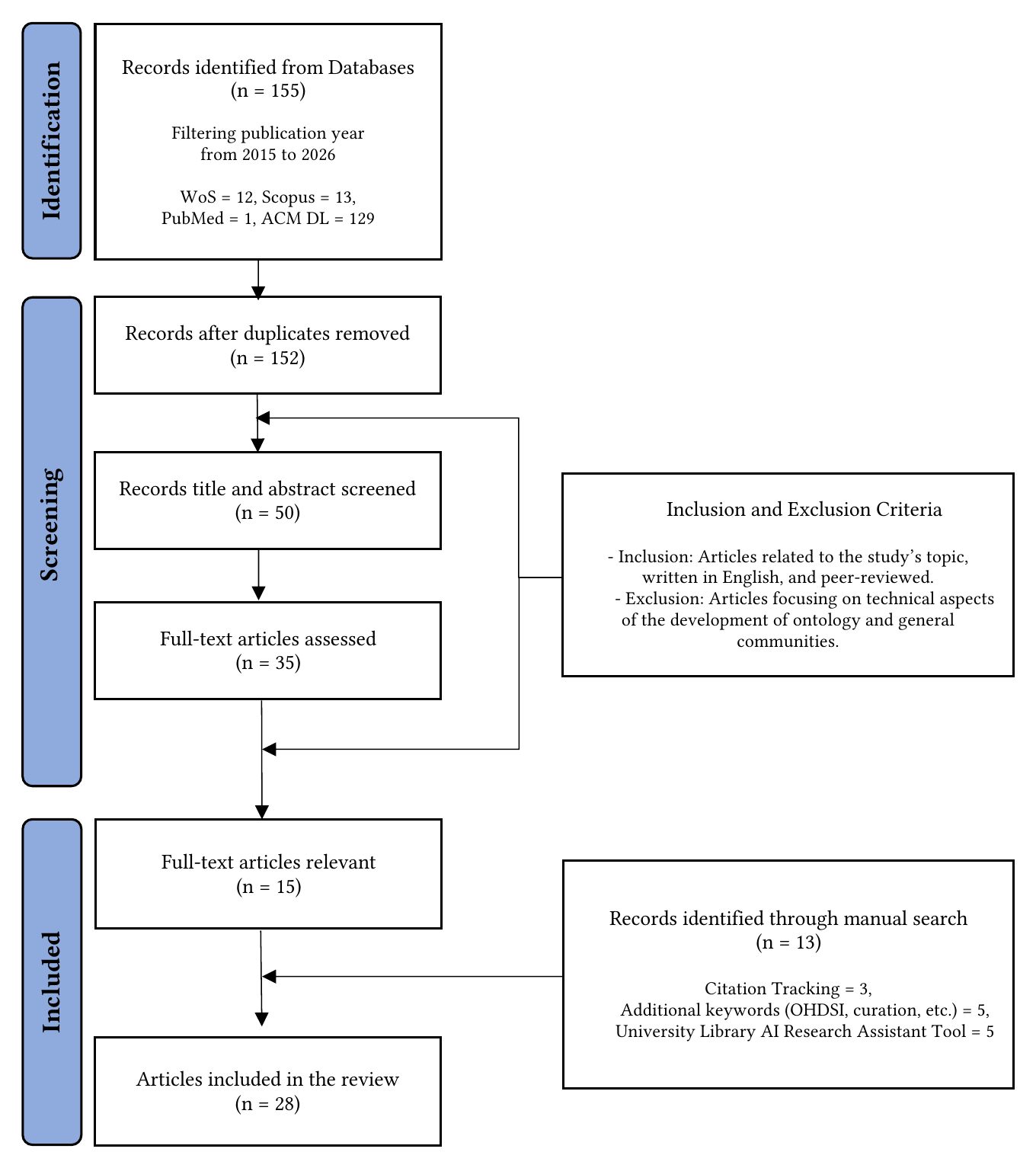
This literature review employed an iterative search strategy in Web of Science (WoS), Scopus, PubMed, and ACM Digital Library to identify peer-reviewed articles published between 2015 and 2026. The search terms were biomedical ontology, biocuration, motivation, community, and human-AI collaboration. This search was further supplemented by citation tracking. Studies on knowledge sharing and specific biomedical ontology communities, such as OHDSI, fell within the inclusion criteria; however, purely technical ontology engineering papers focusing on the development of individual biomedical ontologies were excluded during the title and abstract screening phase. Through this systematic screening process, 28 articles were finally selected for thematic content analysis. The detailed search strategy flow diagram is shown in Appendix A.
2.3 Data Analysis
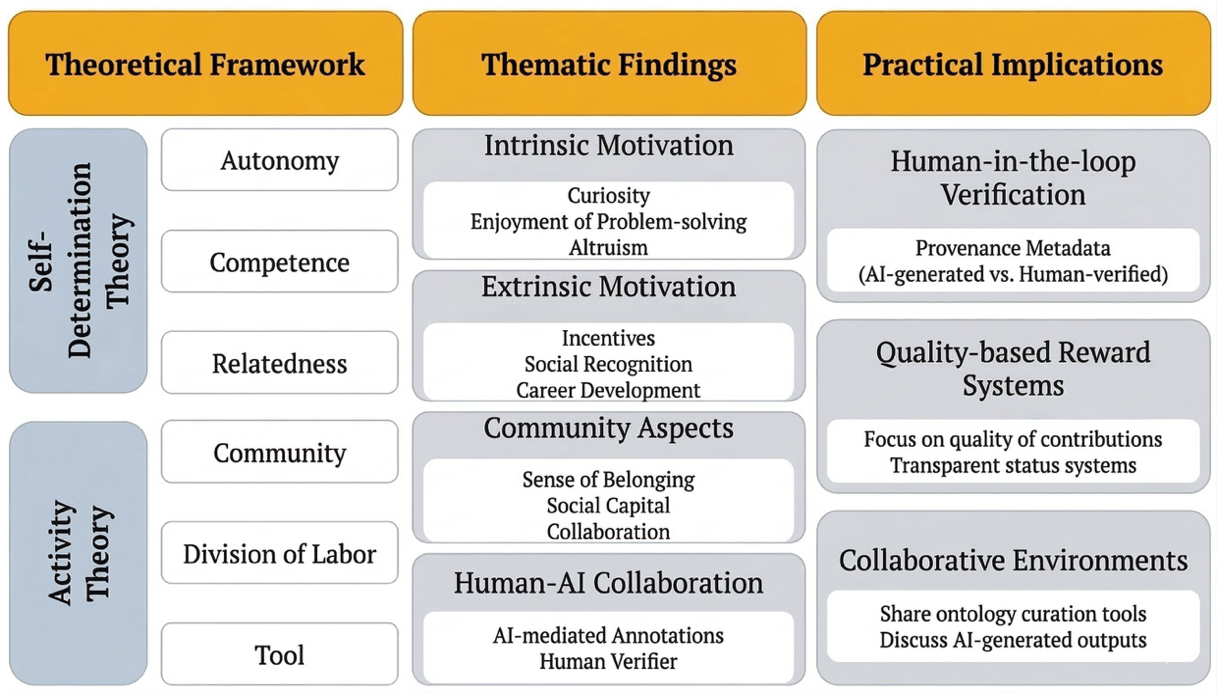
Based on the theoretical framework, this study employed a hybrid approach to thematic content analysis, combining deductive and inductive coding to identify key themes. Specifically, SDT's three needs (autonomy, competence, and relatedness) captured individuals' motivation, while AT guided the sociotechnical analysis of the community itself, GenAI tools, and the shifting division of labor. Following this, themes were refined through an inductive approach: narrower subthemes (curiosity, enjoyment, and altruism) were grouped under broader themes, such as Intrinsic Motivation. This iterative process ensured that both psychological and sociotechnical factors were systematically integrated.
3 Findings
As shown in Figure 1, the hybrid thematic analysis identified four major themes shaping participation in biomedical ontology communities: intrinsic motivation, extrinsic motivation, community aspects, and human-AI collaboration.
3.1 Intrinsic Motivation
Intrinsic motivation refers to engagement driven by inherent interest rather than external rewards[34]. Intrinsic motivation includes intellectual curiosity driven by information needs and satisfaction from sharing knowledge[15, 24, 28]. For instance, in the survey by[24], biocurators rated curiosity at 4.14 and enjoyment in solving complex problems at 4.39 (both on a 5-point scale). From an SDT perspective, curiosity reflects autonomy (self-directed exploration), and enjoyment of problem-solving reflects competence (experiencing expertise). Intrinsically motivated individuals demonstrate greater openness to diverse information sources and a willingness to explore conceptual connections, fostering creativity and flexible thinking[15].
Furthermore, altruism, which means the inherent desire to help others and contribute to the social good[27], serves as another powerful intrinsic driver. Driven by deeply held personal values, altruistic individuals are more likely to share tacit knowledge[28]. They also voluntarily contribute their expertise, effectively bridging individual intrinsic motivation with broader community engagement[18].
3.2 Extrinsic Motivation
Extrinsic motivation refers to doing activities to achieve separable outcomes, which differ from intrinsic motivation[34]. Extrinsic motivation encompasses both tangible rewards and social benefits, such as recognition and career development[31, 32]. For instance, micropublication systems effectively motivate participation through multiple incentives, such as citable publication credit, streamlined peer-review process, direct database integration, and professional recognition[31]. Similarly, transparent status systems motivate contributors through badges or rankings that publicly acknowledge their contributions[32].
However, excessive reliance on incentives can undermine autonomy[29]. When rewards are perceived as controlling, over-rewarding can shift individuals' focus from voluntary participation to external pressure, threatening their sense of autonomy. For example, tying rewards to the quantity of actions can negatively affect attitudes toward knowledge sharing[29]. Consequently, extrinsic rewards play a crucial role in either supporting or undermining curators' basic psychological needs.
3.3 Community Aspects
Community aspects focus on belonging and collaborative knowledge building. This theme draws on SDT's relatedness and AT's community component to explain how and why knowledge is collaboratively constructed. It includes fostering a sense of belonging[17, 18, 27], building social capital[27, 28, 30], and motivating collaboration and sustained engagement[7, 21, 35].
Interestingly, events like OHDSI's "Study-a-thon" have successfully increased participation through structured, time-intensive collaborative formats[35]. These events help participants strengthen their social connections, fulfill their need for relatedness, and standardize the community's tools and rules. Ultimately, these community-driven interactions transform isolated or duplicated curation tasks into collective, shared achievements.
3.4 Human-AI Collaboration
Human-AI collaboration refers to the interaction and cooperation between individuals and AI to complete tasks efficiently[36]. GenAI presents both opportunities and challenges for biomedical ontology communities[8, 9, 11, 22, 37, 38]. On the one hand, these AI tools can rapidly extract concepts and suggest annotations, accelerating curation; on the other hand, LLMs have limitations, including hallucinations, deficient reasoning, and algorithmic bias[9, 11, 37, 38]. Thus, the role of human experts is shifting from creator to verifier[9].
While this shift enhances efficiency, it also challenges the traditional sense of competence. When human work is reduced to merely correcting AI errors, experts may feel that their intellectual contributions are diminished. This dynamic threatens their professional identity and intrinsic motivation, highlighting a critical tension between technological advancement and human psychological needs.
4 Discussion and Conclusion
This study shows that intrinsic and extrinsic motivations are crucial for sustaining engagement in biomedical ontology communities. While GenAI tools can improve efficiency, they risk constraining curators' and users' autonomy and reducing their sense of competence[39]. Therefore, sustaining volunteerism requires human-centered infrastructures that protect these psychological needs, which is fundamental to ensuring metadata quality.
To achieve this, community stakeholders should design workflows that support these motivational factors. First, communities should implement human-in-the-loop verification systems in the curation process[22]. For instance, by indicating the provenance metadata[25] of AI or human contributions, curators can apply their expertise and maintain their professional identity. Second, incentive structures should emphasize the quality and impact of contributions rather than sheer volume[22, 31, 32]. Transparent status systems that showcase correction statistics or collaborative efforts can reinforce users' competence without crowding out intrinsic motivation[32]. Third, establishing collaborative environments is essential to fulfill the psychological need for relatedness[40]. Infrastructures should provide shared spaces where users can share ontology curation tools and jointly discuss or verify AI-generated outputs[22]. Recognizing these consensus-building efforts fosters mutual trust and sustains social capital within the community.
As an initial literature-based synthesis, this study has certain limitations. While the selected articles provided saturated qualitative insights, this synthesis may not capture the full diversity of ontology communities. Subsequent research should expand beyond successful cases like OHDSI and BioPortal to broader OntoPortal Alliance ecosystems, such as MedPortal, to capture more comprehensive motivational themes. Theoretically, this study extends SDT and AT to AI-mediated ontology curation contexts. Building on this conceptual foundation, future work will employ empirical, mixed-methods studies with community members to examine how AI-mediated tools and incentive structures can best sustain human contributions in scientific communities.
Acknowledgements
The author thanks Professors Margaret Sullivan, Besiki Stvilia, and Zhe He in the School of Information at Florida State University for their valuable guidance throughout this research.
References
- [1] R. Studer, V. R. Benjamins, and D. Fensel, Knowledge engineering: Principles and methods. Data & Knowledge Engineering, vol. 25, pp. 161-197, 1998. https://doi.org/10.1016/S0169-023X(97)00056-6.
- [2] C. H. Bernabé, The use of foundational ontologies in biomedical research. Journal of Biomedical Semantics, vol. 14, no. 21, 2023. https://doi.org/10.1186/s13326-023-00300-z.
- [3] L. Elmhadhbi, M.-H. Karray, and B. Archimède, Toward the use of upper-level ontologies for semantically interoperable systems: An emergency management use case. Enterprise Interoperability VIII, vol. 9, pp. 131-140, 2019. https://doi.org/10.1007/978-3-030-13693-2_11.
- [4] B. E. Dixon, Extending an open-source tool to measure data quality: Case report on Observational Health Data Science and Informatics (OHDSI). BMJ Health & Care Informatics, vol. 27, no. e100054, 2020. https://doi.org/10.1136/bmjhci-2019-100054.
- [5] C. Reich, OHDSI standardized vocabularies—a large-scale centralized reference ontology for international data harmonization. Journal of the American Medical Informatics Association, vol. 31, pp. 583-590, 2024. https://doi.org/10.1093/jamia/ocad247.
- [6] M. A. Musen, The National Center for Biomedical Ontology. Journal of the American Medical Informatics Association, vol. 19, pp. 190-195, 2012. https://doi.org/10.1136/amiajnl-2011-000523.
- [7] J. Vendetti, BioPortal: An open community resource for sharing, searching, and utilizing biomedical ontologies. Nucleic Acids Research, vol. 53, pp. W84-W94, 2025. https://doi.org/10.1093/nar/gkaf402.
- [8] A. Stenhouse, A vision of human–AI collaboration for enhanced biological collection curation and research. BioScience, vol. 75, pp. 457-471, 2025. https://doi.org/10.1093/biosci/biaf021.
- [9] X. Li, A conceptual framework for human–AI collaborative genome annotation. Briefings in Bioinformatics, vol. 26, no. bbaf377, 2025. https://doi.org/10.1093/bib/bbaf377.
- [10] V. K. Keloth, Social determinants of health extraction from clinical notes across institutions using large language models. npj Digital Medicine, vol. 8, no. 287, 2025. https://doi.org/10.1038/s41746-025-01645-8.
- [11] J. H. Niyonkuru, Leveraging generative AI to accelerate biocuration of medical actions for rare disease. Genetic and Genomic Medicine, 2024. https://doi.org/10.1101/2024.08.22.24310814.
- [12] K. Zhu, C. Li, S. Ou, and W. Chansanam, Large Language Models–driven construction of a spatial-narrative knowledge graph for Beijing's central axis. in Proceedings of the International Conference on Dublin Core and Metadata Applications, DCMI '25, Dublin Core Metadata Initiative, Dublin, OH, USA, 2025. https://doi.org/10.23106/dcmi.952524296.
- [13] B. Smith, The OBO Foundry: Coordinated evolution of ontologies to support biomedical data integration. Nature Biotechnology, vol. 25, pp. 1251-1255, 2007. https://doi.org/10.1038/nbt1346.
- [14] R. Lario, A method for structuring complex clinical knowledge and its representational formalisms to support composite knowledge interoperability in healthcare. Journal of Biomedical Informatics, vol. 137, no. 104251, 2023. https://doi.org/10.1016/j.jbi.2022.104251.
- [15] S. Suwanti, Intrinsic motivation, knowledge sharing, and employee creativity: A self-determination perspective. International Journal of Scientific & Technology Research, vol. 8, pp. 623-628, 2019. https://www.ijstr.org/final-print/july2019/Intrinsic-Motivation-Knowledge-Sharing-And-Employee-Creativity-A-Self-determination-Perspective.pdf.
- [16] S. Barab, S. Schatz, and R. Scheckler, Using activity theory to conceptualize online community and using online community to conceptualize activity theory. Mind, Culture, and Activity, vol. 11, pp. 25-47, 2004. https://doi.org/10.1207/s15327884mca1101_3.
- [17] L. Dong, L. Huang, J. (Jove) Hou, and Y. Liu, Continuous content contribution in virtual community: The role of status-standing on motivational mechanisms. Decision Support Systems, vol. 132, no. 113283, 2020. https://doi.org/10.1016/j.dss.2020.113283.
- [18] A. A. Stukas, M. Snyder, and E. G. Clary, Understanding and encouraging volunteerism and community involvement. The Journal of Social Psychology, vol. 156, pp. 243-255, 2016. https://doi.org/10.1080/00224545.2016.1153328.
- [19] S. E. Ali-Khan, L. W. Harris, and E. R. Gold, Motivating participation in open science by examining researcher incentives. eLife, vol. 6, no. e29319, 2017. https://doi.org/10.7554/eLife.29319.
- [20] J. Hastings, The BSSO Foundry: A community of practice for ontologies in the behavioural and social sciences. Wellcome Open Research, vol. 9, no. 656, 2024. https://doi.org/10.12688/wellcomeopenres.23230.1.
- [21] S. Liu, A framework for understanding an open scientific community using automated harvesting of public artifacts. JAMIA Open, vol. 7, no. ooae017, 2024. https://doi.org/10.1093/jamiaopen/ooae017.
- [22] S. Tsaneva and M. Sabou, Enhancing human-in-the-loop ontology curation results through task design. Journal of Data and Information Quality, vol. 16, pp. 1-25, 2024. https://doi.org/10.1145/3626960.
- [23] D. L. Rubin, N. H. Shah, and N. F. Noy, Biomedical ontologies: A functional perspective. Briefings in Bioinformatics, vol. 9, pp. 75-90, 2007. https://doi.org/10.1093/bib/bbm059.
- [24] S. Burge, Biocurators and biocuration: Surveying the 21st century challenges. Database, vol. 2012, no. bar059, 2012. https://doi.org/10.1093/database/bar059.
- [25] D. J. Lee, B. Stvilia, F. Gunaydin, and Y. Pang, Developing a data quality assurance ontology for research data repositories. Journal of Documentation, vol. 81, pp. 63-84, 2025. https://doi.org/10.1108/JD-09-2024-0212.
- [26] R. M. Ryan and E. L. Deci, Self-determination theory and the facilitation of intrinsic motivation, social development, and well-being. American Psychologist, vol. 55, pp. 68-78, 2000. https://doi.org/10.1037/0003-066X.55.1.68.
- [27] J. S. Carrera, P. Brown, J. G. Brody, and R. Morello-Frosch, Research altruism as motivation for participation in community-centered environmental health research. Social Science & Medicine, vol. 196, pp. 175-181, 2018. https://doi.org/10.1016/j.socscimed.2017.11.028.
- [28] B. Obrenovic, The enjoyment of knowledge sharing: Impact of altruism on tacit knowledge-sharing behavior. Frontiers in Psychology, vol. 11, no. 1496, 2020. https://doi.org/10.3389/fpsyg.2020.01496.
- [29] G.-W. Bock, R. W. Zmud, Y.-G. Kim, and J.-N. Lee, Behavioral intention formation in knowledge sharing: Examining the roles of extrinsic motivators, social-psychological forces, and organizational climate. MIS Quarterly, vol. 29, no. 87, 2005. https://doi.org/10.2307/25148669.
- [30] S.-W. Lin and L. Y.-S. Lo, Mechanisms to motivate knowledge sharing: Integrating the reward systems and social network perspectives. Journal of Knowledge Management, vol. 19, pp. 212-235, 2015. https://doi.org/10.1108/JKM-05-2014-0209.
- [31] D. Raciti, K. Yook, T. W. Harris, T. Schedl, and P. W. Sternberg, Micropublication: Incentivizing community curation and placing unpublished data into the public domain. Database, vol. 2018, 2018. https://doi.org/10.1093/database/bay013.
- [32] M. Zhou, M. Song, and W. Fan, User's online status and knowledge contribution behavior in the Q&A community—based on core and non-core contributors. Information & Management, vol. 63, no. 104260, 2026. https://doi.org/10.1016/j.im.2025.104260.
- [33] V. Kaptelinin and B. Nardi, Activity theory in HCI: Fundamentals and reflections. Synthesis Lectures on Human-Centered Informatics, 2012. https://doi.org/10.1007/978-3-031-02196-1.
- [34] R. M. Ryan and E. L. Deci, Intrinsic and extrinsic motivation from a self-determination theory perspective: Definitions, theory, practices, and future directions. Contemporary Educational Psychology, vol. 61, no. 101860, 2020. https://doi.org/10.1016/j.cedpsych.2020.101860.
- [35] N. Hughes, Evaluating a novel approach to stimulate open science collaborations: A case series of 'study-a-thon' events within the OHDSI and European IMI communities. JAMIA Open, vol. 5, no. ooac100, 2022. https://doi.org/10.1093/jamiaopen/ooac100.
- [36] J.-Q. Xu, T.-J. Wu, W.-Y. Duan, and X.-X. Cui, How the human–artificial intelligence (AI) collaboration affects cyberloafing: An AI identity perspective. Behavioral Sciences, vol. 15, no. 859, 2025. https://doi.org/10.3390/bs15070859.
- [37] D. Garijo, LLMs for ontology engineering: A landscape of tasks and benchmarking challenges. in Proceedings of the International Semantic Web Conference 2024, ISWC '24, 2024. https://ceur-ws.org/Vol-3953/364.pdf.
- [38] Q. Liu and J. Qin, The role of ontologies in machine learning: A case study of gene ontology. in Proceedings of the iConference 2025, iConf '25, Information Research, 2025. https://doi.org/10.47989/ir30iConf47575.
- [39] M. Gagné, Understanding and shaping the future of work with self-determination theory. Nature Reviews Psychology, vol. 1, pp. 378-392, 2022. https://doi.org/10.1038/s44159-022-00056-w.
- [40] N. Law, The role of generative AI in collaborative problem-solving of authentic challenges. British Journal of Educational Technology, no. bjet.70010, 2025. https://doi.org/10.1111/bjet.70010.
Appendix A Search Strategy Flow Diagram
Download this article’s references: BibTeXRISCSL-JSONHayagriva
Article details
- Published
- Section
- Short Papers
- Published in
- DCMI-2026 Seoul, South Korea Proceedings
- License
- CC BY 4.0 · open access
- Download
- Download PDF
- Markdown
- Markdown
 Described in Dublin Core
This article's metadata, in the vocabulary these proceedings are about.
- dcterms:title
- Motivations for Participating in Biomedical Ontology Communities within Human-AI Collaboration
- dcterms:creator
- Seo, Jiwoo
- dcterms:date
- 2026-09-10
- dcterms:identifier
- doi:10.23106/dcmi.952650833
- dcterms:isPartOf
- DCMI-2026 Seoul, South Korea Proceedings
- dcterms:publisher
- Dublin Core Metadata Initiative
- dcterms:type
- Text
- dcterms:language
- en
- dcterms:rights
- CC BY 4.0