

1Introduction
In a broad sense, the gradual transformation of bibliographic description is rooted in a more precise formalization of the concept of Work, as explored by foundational authors such as Richard P. Smiraglia and Elaine Svenonius in the late 1990s and early 2000s. From this scholarly tradition emerges the importance of formalizing the relationships between works and other resources, understood as modelable entities systematized in the conceptual frameworks of the FRBR family of models (Riva, Le Boeuf, & Žumer, 2017) and their rigorous implementation in the RDA descriptive rules, accompanied by vocabularies for resource description and cataloging. The concept of Work has also proven applicable to representing many other forms of publishing or materializing information, and has recently been formalized in the OpenWEMI specification within the Dublin Core Metadata Initiative. We follow this generalizing approach as developed by researcher Karen Coyle in numerous contributions [5]. It may be said that resource description in the contemporary bibliographic universe is based more on establishing connections between resources than on merely recording their attributes [13]. The emerging future of bibliographic information systems lies in metadata connection, openness, enrichment, and filtering [2].
In this paper, we focus specifically on derivative relationships between works, understood within the framework of LRM-FRBR and its core proposal of the WEMI entities (Work, Expression, Manifestation, Item). In the literature, terms such as "FRBRizing" or "Bibliographic families" are commonly used, reflecting the growing need to enable higher-quality navigation across interconnected information resources. We also incorporate the perspective of BIBFRAME, as an initiative aimed at producing well-connected bibliographic records that overcome the evident limitations of the MARC format [8, 1].
The aim of this paper is to present a systematic exploratory analysis to understand how the Wikidata community—without specific knowledge of the FRBR data model and without intending to implement it—is nonetheless using it to describe creative works through structured data. Since Wikidata is not a holding bibliographic catalog, the initial assumption is that item-level data will not be present; however, it does allow for the observation of how, in practice, the challenges posed by the Work–Expression–Manifestation levels are addressed. Additionally, the study examines other significant relationships between works, as established by data-savvy encyclopedists, in a multidomain context. This includes a systematic exploration of records describing large volumes of creative works across four domains: audiovisual, musical, literary, and video games.
1.1From WEMI to Derivative Relationships: Toward a More Flexible and Contextual Bibliographic Representation
The FRBR-LRM conceptual model structures the notion of a work through four hierarchically related entities: Work, Expression, Manifestation, and Item—collectively known by the acronym WEMI. This architecture aims to represent the progression from intellectual abstraction to physical instantiation. However, in practice, numerous situations arise that complicate the strict application of these distinctions. A notable example is the BIBFRAME model, which simplifies WEMI into just three levels—Work, Instance, and Item—by integrating the Expression level into Work and focusing representation on tangible manifestations. In light of this simplification and similar challenges, a more flexible approach to bibliographic relationships becomes increasingly relevant—one that is adapted to specific usage contexts and oriented toward user needs within platforms broader in scope than the traditional library catalog [6].
The difficulty in precisely delimiting relationships between bibliographic resources has led to broader conceptualizations, such as the notion of "bibliographic families," introduced by Barbara Tillett (2001). This concept enables a deeper understanding of the spectrum of links between entities representing the same work or related works, as well as the multiple meanings these relationships can take on. Tillett proposes a typology for relationships outside the WEMI framework—referred to as non-WEMI relationships—which includes categories such as: equivalent, derivative, descriptive, whole-part, accompanying, and sequential. These classifications have been instrumental in understanding how resources are connected beyond the strict hierarchy of the FRBR model.
Complementing this perspective, Richard Smiraglia (2001; 2019) has examined works with extensive publishing histories and multiple editions, identifying how these give rise to complex networks of influence stemming from a "progenitor" work. Within this context, descriptive relationships—such as citations, reviews, or commentaries—are also integrated, forming part of the fabric of academic research and cultural criticism, and expanding the semantic universe of works beyond their material publication.
Bibliographic models based on the FRBR-LRM framework are founded on the principle that the Work acts as the central organizing entity, further specified through the hierarchical WEMI chain. This hierarchical sequence is intended not only to represent the progression of an intellectual idea toward its material realization but also to facilitate the identification of variants of the same work. This logic has been adopted and adapted by models such as that of the International Federation of Film Archives (FIAF) and the DCMI OpenWEMI schema.
However, when addressing relationships between distinct works or more indirect connections, modeling becomes more complex and less rigid. For example, the Library Reference Model (2017) defines a limited but meaningful set of relationships between WEMI entities, categorized using codes such as LRM-RX. Some of these relationships capture strong hierarchical links (such as realization or instantiation), while others introduce intellectual or creative connections, such as inspiration (R21), transformation (R22), or derivation (R24).
In contrast, BIBFRAME simplifies the original FRBR structure by reducing the first three WEMI levels to just two: Work and Instance. In this compression, the Expression level is subsumed under Work. Since 2021, BIBFRAME has also incorporated the Hub class to represent broader conceptual aggregations. While this simplification makes the model more manageable, it has also been criticized for its limited relational richness compared to RDA. Nevertheless, BIBFRAME allows for the expression of multiple types of relationships through properties such as bf:relatedTo and its subproperties, or through the dedicated vocabulary bibframe:relationship, which contains up to 168 distinct concepts (e.g., "based on," "part of," "prequel," etc.).
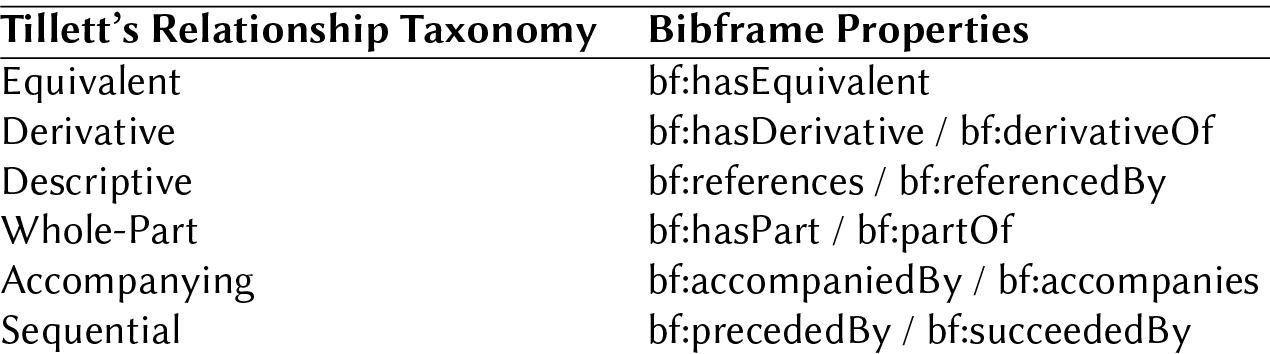
Zapounidou et al. (2019) conducted a mapping exercise between Tillett's taxonomy of relationships, RDA properties, and BIBFRAME properties, which allows for the identification of approximate correspondences [17]. This analysis demonstrates that, although the approaches differ in structure, they share similar objectives: to adequately represent the various types of relationships between resources. The correspondence is summarized below in Tables 1 and 2:
Table 1 Tillett's Relationship Taxonomy and Its Mapping to RDA. Source: Zapounidou et al. 2019, p. 281
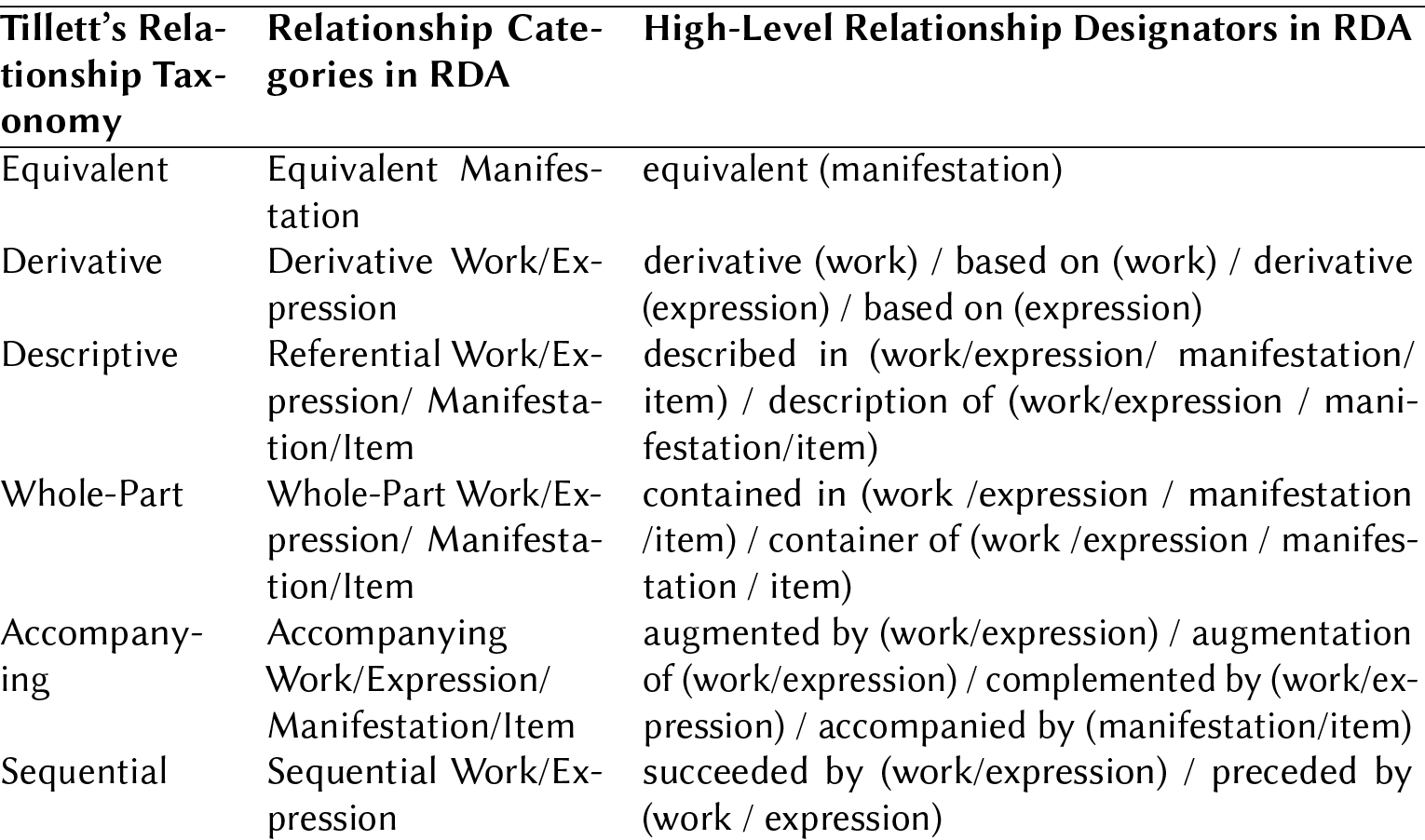
Table 2 Tillett's Relationship Taxonomy and Its Mapping to BIBFRAME. Source: Zapounidou et al. 2019, p. 283
The inherent ambiguity of the "work" concept and the practical difficulties in clearly distinguishing between expressions and manifestations have led authors such as Fremery and Buckland (2023) to fundamentally reconsider the FRBR model. In their research The Work in Question, they propose understanding the work not as a predefined entity, but rather as a functional construct—adaptable to the specific needs of users and the institutions that organize information.
Instead of following a top-down approach that moves from conceptual abstraction to concrete instances, Fremery and Buckland advocate for a reverse, bottom-up logic. From this perspective, a "work" can be understood as a set of resources grouped based on their shared utility, rather than on an assumed common creative essence. In this way, the work becomes a flexible epistemic device—a tool for organizing resources according to how they may be useful or meaningful to users within specific socio-historical contexts.
This perspective also enables the design of catalogs that are more attuned to the actual interests of readers and less constrained by traditional library conventions. Rather than asking whether an item belongs to a work based on normative criteria, the question becomes how to group objects in ways that are useful to those seeking them. The authors refer to these as "usefully similar gatherings"—relationships that are meaningful from the diverse perspectives of different users or application contexts. These groupings may follow thematic, stylistic, functional, or even personal criteria. For example, Netflix does not organize its content by author but by experiential categories such as "films with unexpected twists" or "action with a touch of comedy." Applying a similar logic to bibliographic catalogs could enable richer, more natural, and more satisfying discovery pathways for users.
In this alternative approach, frameworks such as FRBR or BIBFRAME are not discarded but reinterpreted. Their hierarchical structure may still be useful—not as an ontological truth, but as a flexible convention among many possible ways of organizing knowledge. The key lies in enabling users to navigate and rediscover resources through dynamic groupings, defined by their own interests or by algorithms that detect meaningful similarities—ranging from thematic to material, or even emotional dimensions.
Ultimately, the contemporary challenge of cataloging lies not so much in perfecting normative models, but in developing systems capable of capturing and representing meaningful relationships between resources—relationships that are adapted to the many ways in which users explore, interpret, and use information. The concept of "work" ceases to be a stable essence and instead becomes a relational instrument, one that can vary depending on context, community, technology, or even historical moment.
Models such as FRBR-LRM and BIBFRAME have marked important advances toward a more structured organization of bibliographic knowledge. However, their applicability becomes limited when a single logic is imposed on a diverse and constantly evolving reality. Recent critiques—such as those put forward by Fremery and Buckland—highlight the need for more open, pragmatic, and situated models, capable of aligning with the real interests of readers and offering more empathetic and effective discovery pathways.
In this sense, the shift from an approach centered on static entities to one based on the previously mentioned "usefully similar" groupings represents a paradigm change: from a logic of control to a logic of utility. It entails recognizing that knowledge organization systems must be adaptable tools—designed not only to represent normative bibliographic relationships, but also to support meaningful exploration of a broad, diffuse, and networked informational universe.
Thus, understanding and mapping relationships between informational objects—whether intellectual derivations, critical citations, adaptations, or simply thematic affinities—becomes a key pathway for designing better information systems: more inclusive, adaptable, and user-centered.
2Wikidata as a Bibliographic Instrument
Wikidata is a knowledge base initially conceived to provide unified structured data to support Wikipedia articles across all languages, and to connect articles in different languages that refer to the same concept, fact, or entity. Wikidata was created to support encyclopedic information, with a focus on data, and it is important to recall that one of the key policies of this online encyclopedia is that it "is not a catalog." However, information related to the bibliographic universe is both abundant and significant [10]. Hundreds of thousands of items have been registered to describe and identify creative works—literary works, comics, films, songs, music, theater, and publications in a broad sense.
In most cases, the items correspond to works that have reached a sufficient level of notability to merit an encyclopedic article in one or more languages. However, there are also items in Wikidata that are purely bibliographic metadata records, with no connection to any article. The Wikidata project has generated significant interest within the library and linked (meta)data communities due to its ability to act as a central hub for connecting otherwise separate databases—especially through identifiers that link authority records [3, 15]. It is important to note that, since Wikidata is not a catalog either, its use for registering scholarly publications (research papers) in the Scholia project has required a database split in order to maintain performance [9].
In the Wikidata WikiProject on Books, it is noted that an approach similar to BIBFRAME is adopted. The project favors simplicity and ease of use, appropriate for a non-professional, multidomain community, in which works and editions are identified. Table 3 shows the properties commonly used to declare the type at the Work level and at the Instance level for written works:
Table 3 Triples with URNs for Subjects (S), Properties (P), and Property Values (PV). Source: own work

In other types of creative works—such as films, series, paintings, comics, or theater—descriptive practices vary. Across these domains, we find a wide range of properties, many of which reflect relationships between creative works that echo Tillett's concept of bibliographic families. In total, over two million items (2,223,321) have been identified as creative works across the four major categories: musical works, literary works, audiovisual works, and games.
Table 4 Number of Items for Each of the Four Parent Categories and Their URNs. Source: own work
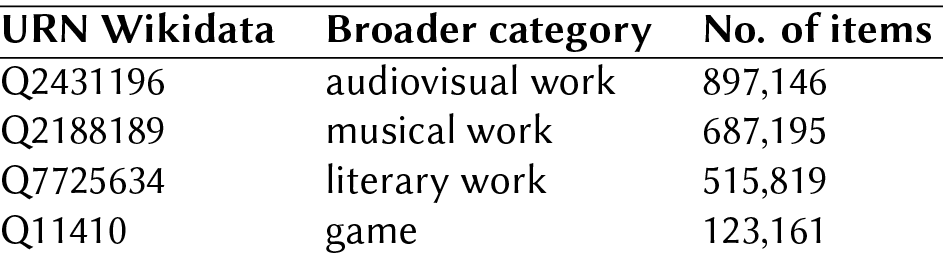
To conduct a broad observation of resource descriptions in Wikidata, subclasses directly linked to these parent categories were selected, focusing on those with a significant number of assigned works, while discarding those with low usage or that were overly specific. Table A-1 in the Appendix lists the 83 specific subclasses used for data extraction, along with the number of items retrieved for each.
3Analysis of Relationships Between Works in Wikidata
Based on a large set of records for creative works representative of today's content industries (film, music, video games, and literature), the analysis focused on the relationships established between items belonging to these categories. A total of 1,734,286 relationships were identified among more than 2 million selected resources (as either the source or target of the relationship). The following summary presents the relationships found across the four major categories processed, with audiovisual works and music showing particular prominence.
Table 5 Relationships Generated by Work Records in the Content Industry. Source: own work
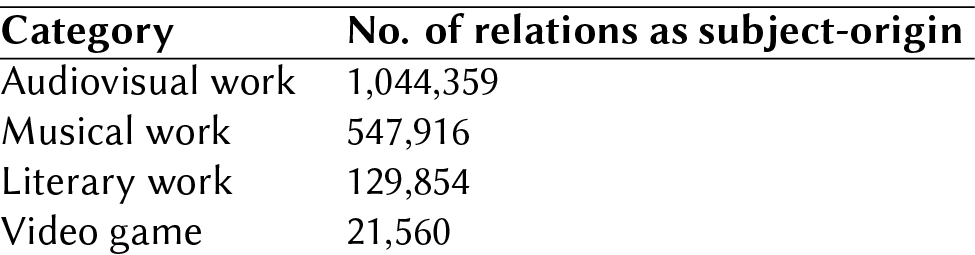
To examine this in greater detail, we have delimited the relationships each category establishes with the others. Once again, the importance of connections between works of the same type becomes evident. Among the "external" relationships, the most prominent is that between audiovisual works and literature, followed by literature-to-audiovisual and audiovisual-to-music connections.
Table 6 Relationships Between Categories. Source: own work
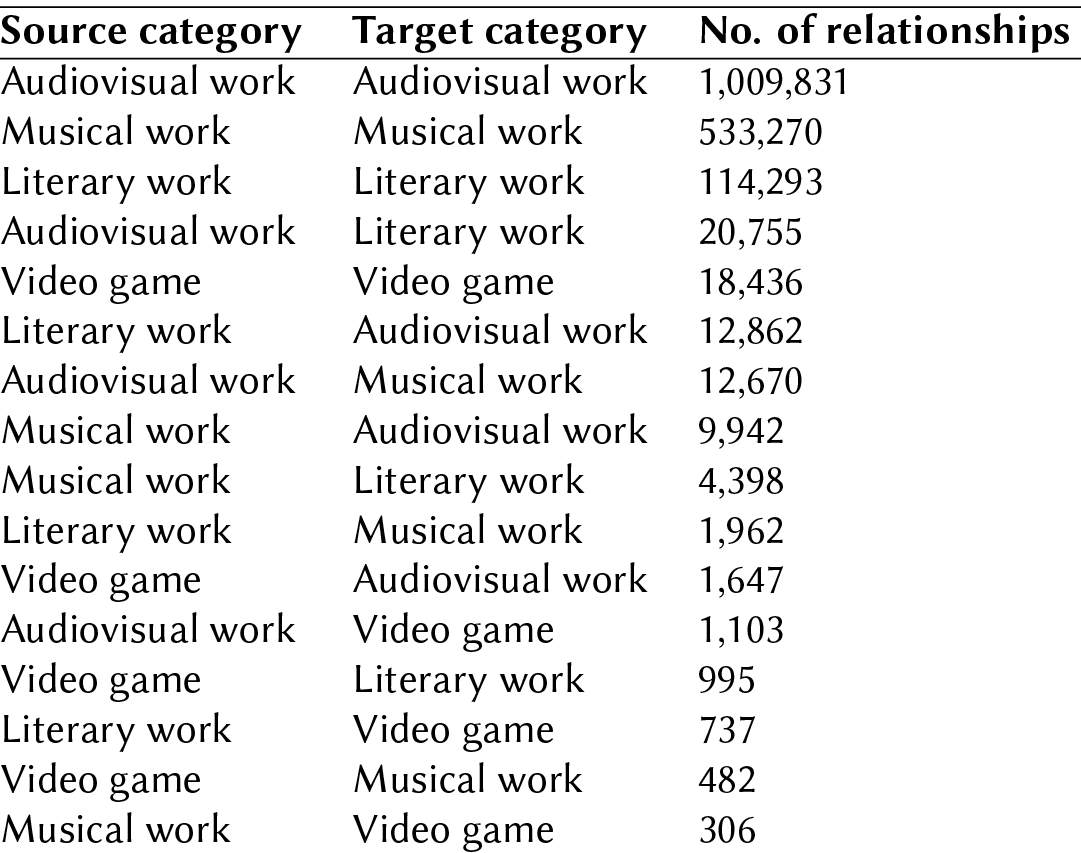
The previous figures were constructed by aggregating relationships in both directions—that is, for example, considering both the relationships from Audiovisual to Literature and those from Literature to Audiovisual. The data reveals not only a dense network of relationships among works of the same type but also extensive connections across different forms of expression and sectors of the content industry.
Within Wikidata, relationships between works are defined through the use of properties. Table A-2 in the appendix presents those cases in which a relationship-property appears more than 100 times. Each identified relationship has been categorized using the well-accepted classifications outlined earlier in the paper, and, where appropriate, new categories have been introduced and are further justified below. The most frequently used properties—each with over 100,000 occurrences—include P155 (follows), P156 (followed by), P179 (part of the series), P527 (has part(s)), P4908 (season), and P361 (part of). Also notable are P144 (based on), used in 37,341 instances, and P4969 (derivative work), with 18,207 instances. Complete data on this 49 relationship-properties identified between works, along with their categorization, can be found in Appendix Table A-2.
Figure 1: Relationships Between Works Within the Same Category. Source: own work
Figure 2: Relationships Between Works Across Different Categories. Source: own work
Applying this categorization, the following table shows the usage level of each category, taking into account that in some cases inverse relationships (e.g., whole–part) are counted separately. When presenting usage data, it is relevant to consider not only the number of specific relationships within each category, but also their application across a broad universe of creative work descriptions. Constructive relationships (such as parts, sequences, and aggregations), which are characteristic of serialized publishing models, appear first. Derivative relationships show slightly greater presence than WEMI relationships. Notably, insertion relationships—where one work is embedded within another—also show a high frequency.
Table 7 Relationship Type, Number of Properties, and Frequency of Use. Source: own work
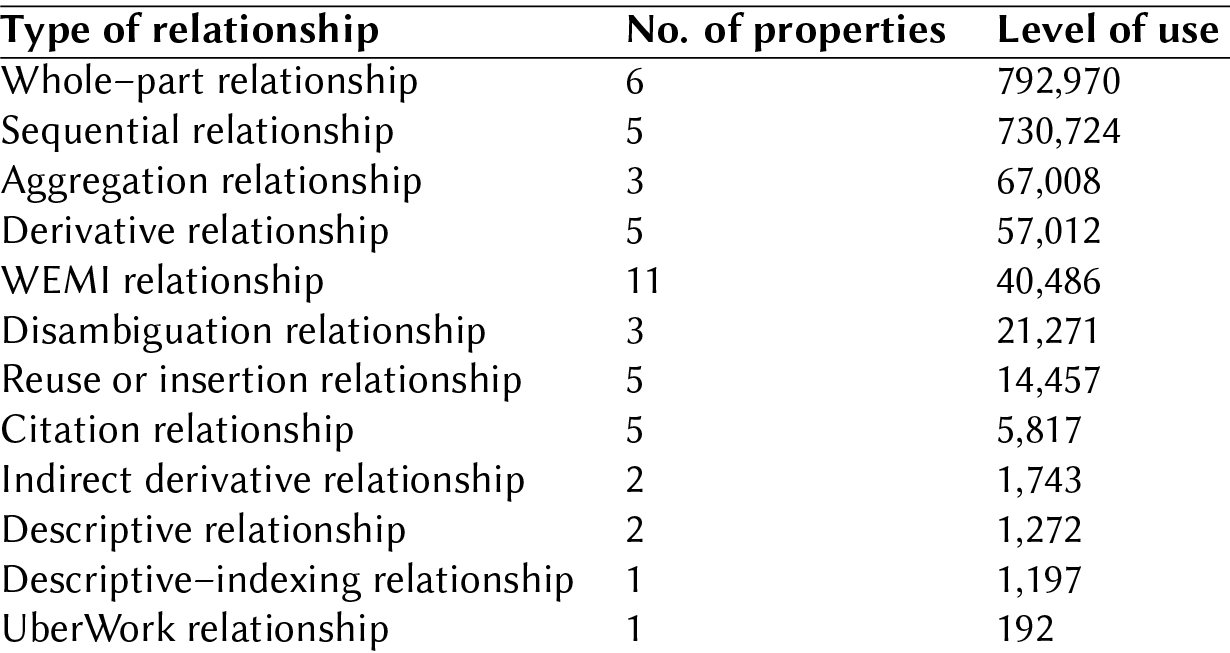
The 49 properties that connect works to one another have been categorized according to commonly used terms in the specialized literature: Sequence relationship; Whole–part relationship; Aggregation relationship; Derivative relationship; WEMI relationship; Descriptive relationship; Citation relationship; and Equivalence relationship. In addition, it was necessary to propose some additional categories to account for properties that represent aspects not sufficiently addressed in current bibliographic models. These new cases are listed and explained below:
- Disambiguation relationship: A relationship of equivalence or approximate correspondence. This relationship indicates that two specific works are distinct, even in cases where they might otherwise be considered the same work. It is related to title homonymy—not only in cases of cross-media versions (e.g., book-film) but also when the same name is used for entirely different works, such as an album and a book.
- Reuse or insertion relationship: The most common example is a song or painting used in a film. These are cases in which one work is integrated into another, often involving copyright or usage rights. This relationship is distinct from citation or mention.
- Indirect derivative relationship: Commonly understood as an artistic "source of inspiration." This is a value-based relationship that reflects creativity or originality in thematic content or expression. It does not involve copyright concerns and belongs to the realm of cultural criticism and interpretation.
- Descriptive-indexing relationship: Refers to works whose main subject is another work. This "indexing" relationship may appear unusual and requires closer examination.
- UberWork relationship: Refers to relationships between works and higher-level aggregations, typically known as "fictional universes" or, more recently, "franchises." These go beyond the traditional grouping into parts and sequences, as seen in cases such as Sherlock Holmes or Star Trek.
At a lower level, other types of relationships can be found, such as inspiration, descriptive, citation, indexing, or fictional universe relationships. When examining citation relationships—which are part of the foundational infrastructure of scholarly publishing and its analysis—it is important to recognize that their use in creative works is of a very different nature: much more indirect and "soft." The analysis of "creative citations" is not systematized; it falls within the realm of cultural criticism and studies, and identifying and recording them in Wikidata represents a considerable challenge. Descriptive relationships likewise belong more properly to the domain of academic and scientific publishing, rather than that of creative works.
It is also possible to gather data on which relationships are most frequently used when describing each of the four general types of creative works included in this study:
Table 8 Most Frequently Used Relationships in Video Games and Musical Works. Source: own work
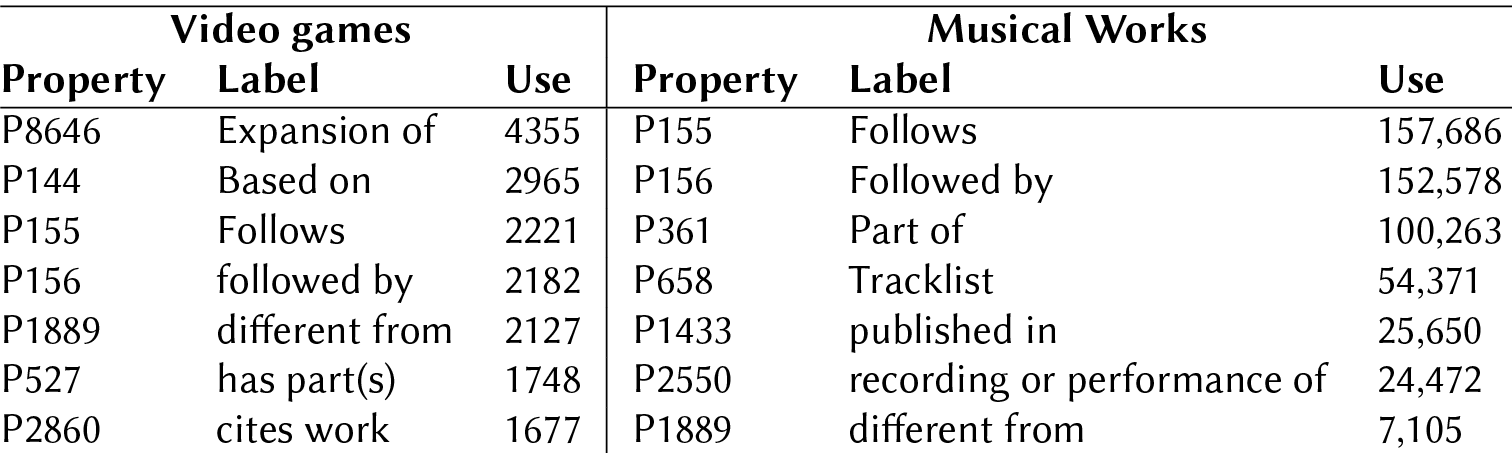
Musical works display a very specific relational structure, linked to the songs that are included in an album, as well as to the distinction between a musical theme and its recorded version or arrangement. In audiovisual works, the data especially highlights relationships that emphasize the importance of seriality.
Table 9 Most Frequently Used Relationships in Audiovisual and Literary Works. Source: own work
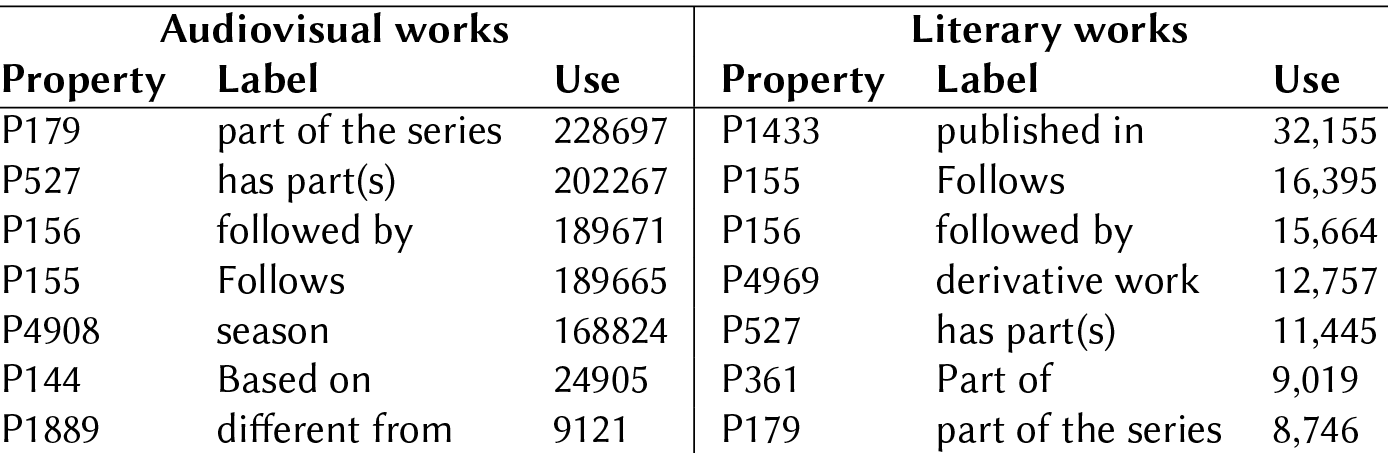
It is noteworthy that in video games, audiovisual works, and music alike, the disambiguation relationship (P1889: different from) between works that may be confused with one another is highly prevalent across different categories.
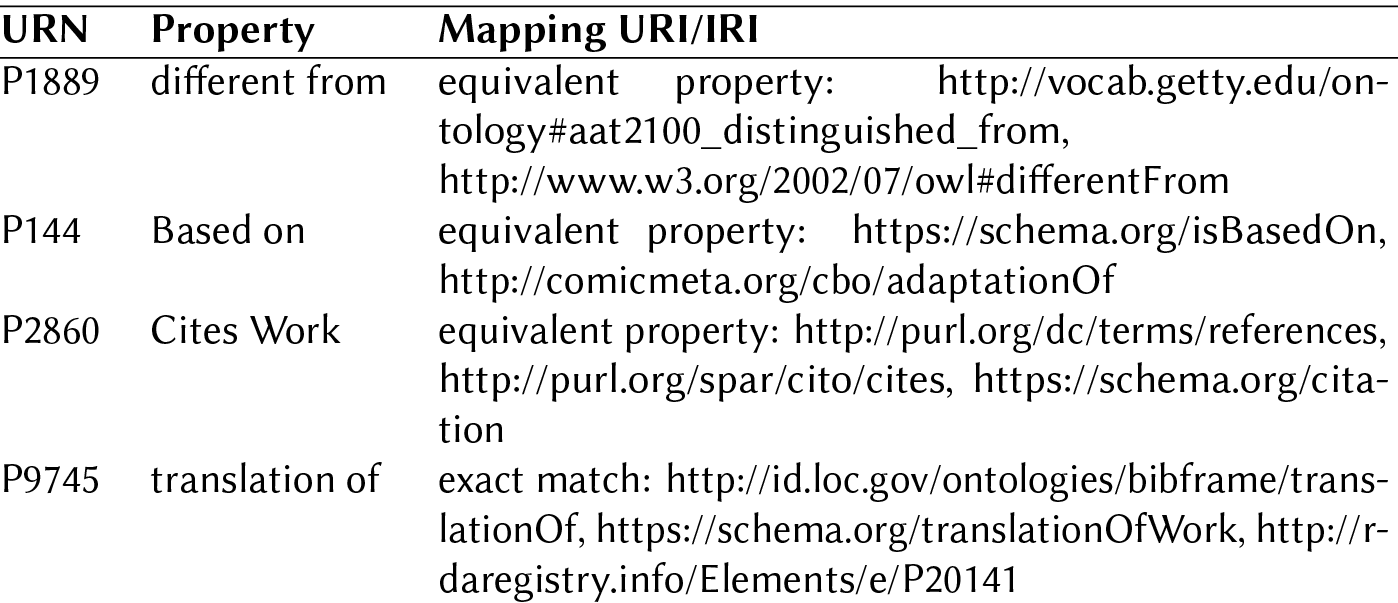
One final aspect—which we will only briefly touch upon in this study—is the mapping of Wikidata properties to other namespaces. This increases the potential for interoperability by using formalizations aligned with Linked Open Data technologies. We present here a few mappings of properties with high usage levels.
Table 10 Examples of Property Mappings Between Wikidata and Other Name Spaces. Source: own work
4Conclusions
The study of relationships between works, based on a vast volume of data recorded in Wikidata and covering main types of content creative works, confirms the presence of derivative relationships and bibliographic families as envisioned in the RDA and BIBFRAME models—though not exclusively. From a perspective of possible limited or partial awareness among the Wikidata editing community, common patterns emerge that promote good practices, while also revealing gaps in the representation of certain fundamental relationships. As such, collaborative practices in Wikidata partially align with bibliographic standardization but diverge in their ability to fully enrich and complete the spectrum of possible relationships between works.
The results reveal that, although both models emphasize strong WEMI relationships (40,486 instances), all other relationships together account for a significantly larger share (1,693,663 instances). Thus, WEMI relationships represent only 2%, compared to the 98% represented by all others. The data also offer a compelling view of the density of transmedia connections—so characteristic of current modes of content production and consumption—which poses a challenge for rethinking priorities in metadata generation and the design of information discovery and consumption environments. The discovery of works, in a broad sense—especially within the content industry platforms—requires mechanisms to formalize most insightful connections and groupings. These should be constructions that reflect specific interests, taste communities, emerging or well-established consumption genres, and cultural connections, combining automated processing and recommendation systems with more connective metadata that reveal relationships between resources. The individual description of items is, in a way, trivial, whereas the real challenge lies in building networks and groupings to provide orientation within the overwhelming production of cultural and consumer content.
For all these reasons, both the improved formalization of these other types of relationships and their more rigorous integration into metadata production processes represent a key opportunity—taking Wikidata as a reference point, with the interests and practices of users who are not necessarily affiliated with the library community.
In summary, the bibliographic models examined—when viewed through the lens of a semantic, community-driven, and open project such as Wikidata—do show a degree of alignment in terms of properties. However, they also suggest the need to move beyond the current limitations of the property sets defined by traditional bibliographic models.
AAppendix
Due to space constraints, the detailed tables A-1 (Number of Items in Each of the Four Categories and Subcategories) and A-2 (Properties connecting Works Used 100 Times or More) listing the 83 specific subclasses used for data extraction and the 49 relationship-properties identified between works are available in the supplementary materials.
 Described in Dublin Core